Asking the right questions before hiring a driving instructor can determine whether you develop confident, safe driving skills — or struggle with anxiety and repeated test failures. Many learners hire the first available instructor without vetting qualifications or teaching compatibility, ending up with impatient teachers, inadequate preparation, or approaches that increase stress.
This guide organizes essential questions into six categories — qualifications, lesson structure, teaching style, test preparation, warning signs, and state-specific requirements — so you know exactly what to ask to find an instructor who gets you test-ready with confidence.
📌
Requirements, fees, and pass rate benchmarks vary by state and instructor. Always verify certification directly on your state DMV website and get all policies in writing before paying for lessons.
40%
Higher First-Time Pass Rate
Students who thoroughly vet their instructor before booking lessons
30%
Fewer Lessons Needed
The right instructor match can reduce your total lesson count significantly
6
Question Categories
Qualifications, structure, style, test prep, red flags, and state requirements
🎓 Instructor Qualifications & Experience
Your driving instructor must hold current state certification, maintain a clean driving record, and ideally have specialized training. Start with the single most important question:
KEY QUESTION“Are you certified by the [State] Department of Motor Vehicles to provide driver education?” — Request their license number and verify it on your state DMV website. Unlicensed instruction is illegal and voids insurance coverage.
Essential Questions to Ask
🪪Certification Proof
“Can I see your state DMV instructor license number so I can verify it online?”
📅Years of Experience
“How many years have you been teaching, and how many students have you taught in total?”
📊First-Time Pass Rate
“What percentage of your students pass their DMV test on the first try?”
🔍Background Check
“Have you undergone a criminal background check, and what does your personal driving record look like?”
👥References
“Can you provide 2–3 references from recent students with similar learning needs to mine?”
🎯Specializations
“Do you specialize in any areas — teen education, adult learners, or anxiety management?”
Experience Level vs. Expected Pass Rate
| Experience Level | Years Teaching | Students Taught | Expected Pass Rate |
|---|
| New Instructor | 1–2 years | 20–50 students | 65–75% |
| Established | 3–5 years | 50–150 students | 75–85% |
| Veteran | 5+ years | 150+ students | 80–90% |
How to Read Their Answers
✅ Green Flags
- Provides verifiable license number
- Shares specific pass rate data
- References available on request
- Mentions specialized training
- Clean driving record confirmed
- Answers confidently and transparently
🚩 Red Flags
- Can’t provide license number
- Claims 100% pass rate
- Vague about student count
- Refuses background check discussion
- No references available
- Deflects or changes the subject
📋 Lesson Structure & Costs
Understanding exactly what you’re paying for — and what’s hidden — protects you from unexpected charges and ensures lessons actually cover all DMV test requirements. Ask these before signing anything.
Lesson Structure Questions to Ask
⏱️
Lesson Duration
“What’s included in a single lesson — actual drive time, pickup, and feedback?” Standard lessons provide 60–90 minutes behind the wheel.
🗺️
Curriculum Coverage
“What specific skills do your lessons cover and in what order?” Expect basic control, lane changes, parking, highway merging, and defensive driving.
🔄
Standard vs. Custom
“Do you follow a standardized curriculum or customize lessons to my needs?” Both are valid — but you should know which approach to expect.
🚘
Complex Maneuvers
“When do you introduce parallel parking and highway merging?” Quality instructors introduce these around lessons 8–12 after mastering fundamentals.
📈
Progress Tracking
“How do you assess and report my progress between lessons?” Look for structured feedback after every session.
📝
Lesson Notes
“Do you provide written post-lesson summaries or skill checklists?” This keeps your learning structured and goal-oriented.
Typical Pricing & Package Breakdown
| Lesson Type | Price Range | Per-Lesson Rate | Typical Savings |
|---|
| Single Lesson (60–90 min) | $60–$90 | $60–$90 | Baseline |
| 10-Lesson Package | $500–$700 | $50–$70/lesson | 10–15% off |
| 15-Lesson Package | $700–$950 | $47–$63/lesson | 15–20% off |
Hidden Fees — Always Ask About These
🚗
Test Vehicle Rental
Using the instructor’s car for your DMV test typically costs $50–$150 extra.
📍
Pickup Surcharge
Pickups outside the service area often incur an extra $10–$25 per lesson.
❌
Late Cancellation Fee
Missing the 24–48 hour notice window typically costs $30–$50 per lesson.
🌧️
Weather Cancellations
Clarify who pays when bad weather forces a cancellation — policies vary widely.
PRO TIPAlways ask: “Are there any additional fees not covered in the quoted price?” Get the full cost breakdown and cancellation policy in writing before paying a single dollar. Lower prices don’t guarantee value — factor in pass rates when comparing instructors.
🤝 Teaching Style & Compatibility
Credentials get an instructor hired — compatibility determines whether you actually learn. An experienced instructor who doesn’t match your learning style can increase anxiety and slow your progress. These questions help you find the right fit before you commit.
Core Teaching Style Questions
1
“What’s your teaching style?”
Listen for whether they adapt to the student or use a fixed, one-size-fits-all method. Strong instructors tailor their pace to your comfort level.
2
“How do you handle student mistakes?”
Quality instructors use constructive feedback: “Let’s try that turn again — this time, slow down earlier and check your mirrors.” Harsh criticism or impatience is a dealbreaker.
3
“How do you prefer to give corrections — during the maneuver or after stopping?”
This affects how well you can process feedback. Clarify this on day one so you’re not startled mid-turn.
4
“Can we go slower than your standard pace if I need it?”
A good instructor will say yes without hesitation. Any reluctance here signals inflexibility that could hold back your progress.
5
“What will we cover in today’s lesson?”
Ask this at the start of every session to set clear expectations and mentally prepare for the skills being covered.
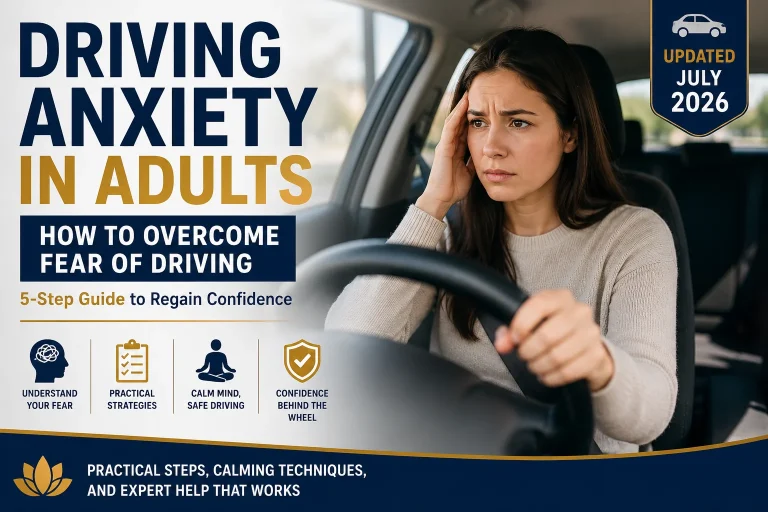
If You Experience Driving Anxiety
💬 Ask directly: “Have you taught students with driving anxiety?”
🌱 Ask about gradual exposure — parking lots first, then quiet streets, then highways
🧘 Ask: “What calming techniques do you use during lessons?”
🗣️ Be upfront: “I experience anxiety — how do you adapt lessons?”
🔴 Red flag: dismissing anxiety with “just get over it”
✅ Good sign: immediate, supportive, specific response
💡
Driving anxiety affects 20–30% of learners. It’s a legitimate need, not a weakness. Professional instructors recognize symptoms like rapid breathing, freezing, and excessive apologizing — and have structured approaches to address them.
Questions for Parents Hiring for Teen Drivers
👨👩👦 Teen-Specific Questions
- “What % of your students are teenagers?”
- “Are you familiar with our state’s GDL requirements?”
- “How do you address distracted driving with teens?”
- “What’s your policy on parent observation?”
- “How do you keep parents updated on progress?”
✅ What Good Answers Look Like
- Specific % of teen students (not vague)
- Knows GDL hours by heart for your state
- Has peer-pressure and distraction curriculum
- Offers regular progress updates (email/text)
- Clear and written observation policy
📝 Test Preparation Questions
A driving instructor’s job isn’t just to teach you to drive — it’s to get you test-ready. Ask these questions to confirm they have a structured, proven approach to DMV exam preparation.
The Essential Test Prep Questions
🗺️Test Route Practice
“Do you practice on actual DMV test routes?” Instructors who do this give you a massive advantage on test day.
🎯Mock Tests
“Do you offer mock tests with scoring?” Students who complete at least one mock test have significantly higher pass rates.
📅Lesson Count to Test
“How many lessons before students typically test?” Beginners usually need 12–15 lessons; experienced drivers 5–8.
🔍Readiness Assessment
“How do you determine when I’m ready to test?” You want an honest answer — not someone who rushes you or delays unnecessarily.
🚗Test-Day Vehicle
“Can I use your car for the DMV test?” Typical rental fee is $50–$150. Confirm this early.
🔄Failure Recovery Plan
“If I fail, what’s the next step?” Instructors should have a clear plan — targeted weakness lessons and a structured retest path.
Why Students Fail — Ask If Your Instructor Drills These
| Failure Reason | Share of Failures | What to Ask Your Instructor |
|---|
| Failure to observe (mirrors/blind spots) | ~40% | Do you explicitly drill mirror and blind spot checks? |
| Right-of-way violations | ~20% | Do we practice intersections and yielding scenarios? |
| Poor speed control | ~15% | How do you teach speed limit awareness? |
| Incomplete stops | ~10% | How do you practice coming to a full stop? |
| Improper lane positioning | ~10% | Do you cover lane centering and positioning exercises? |
How to Gauge Your Own Readiness
🎯 Ask: “On a scale of 1–10, how ready am I?” when you feel close to testing
📋 Request a mock test with a score sheet before booking the real exam
🗺️ Ask to practice on the actual DMV test route at least twice
🚦 Practice every maneuver on the test until it feels automatic
📊 Review your mock test score — aim for consistent 85%+ performance
✅ Ask if your instructor will accompany you to the test site for support
PRO TIPAsk: “Will you tell me honestly if I’m not ready, even if I think I am?” An instructor who would let an underprepared student test prematurely is prioritizing their fee over your success. Honest readiness assessments are the mark of a professional.
🚩 Red Flags to Watch For
Warning signs during your initial interview should never be ignored. Trust your instincts — if something feels off, keep looking. Here are the red flags that should immediately disqualify an instructor:
Credential Red Flags — Walk Away Immediately
🚫
No Proof of Certification
Cannot provide a license number, or the number doesn’t verify on the state DMV website.
📊
Claims 100% Pass Rate
Statistically impossible. Even excellent instructors achieve 80–90%. This is dishonesty.
🤷
Vague Experience Claims
Says “many students” instead of giving specific numbers. Legitimate instructors track their data.
🛡️
No Insurance Proof
Cannot confirm vehicle insurance or liability coverage. You could be driving uninsured.
Professional Behavior Red Flags
⏰
Consistently Late
Lateness without notice or apology signals disrespect for your time and money.
📱
Distracted During Meetings
Texting, eating, or not giving full attention during initial contact is a preview of lesson behavior.
😤
Impatient or Harsh
Yelling, harsh criticism, or dismissing anxiety with “just get over it” will worsen your learning.
🚗
Unprofessional Vehicle
Dirty car, smoking smell, or visible damage indicates poor standards across the board.
Business Practice Red Flags
💰 Payment Red Flags
- Demands full payment upfront
- Cash-only with no receipts
- Price 30–50% below market rate
- No refund policy explained
- Vague about what’s included
📄 Contract Red Flags
- No written contract offered
- Unclear cancellation policy
- Verbal-only promises
- Hesitates to put terms in writing
- Pressure to sign or pay immediately
Safety Red Flags — Non-Negotiable
🛞
No Dual Controls
The instructor’s vehicle must have dual brake/accelerator controls. No exceptions.
⚠️
Poorly Maintained Car
Check engine light on, worn tires, or visible damage means the car isn’t roadworthy for lessons.
🪖
No Seatbelt Enforcement
If the instructor doesn’t wear or enforce seatbelts, they’re modeling exactly the wrong behavior.
🚨
Reckless Pickup Driving
How they drive when picking you up is how they operate. Reckless behavior is an instant disqualifier.
What to Do When You Spot Red Flags
Not every warning sign requires an immediate exit — use this guide to decide when to push back and when to walk away.
If you encounter major red flags — no certification, inappropriate behavior, or an unsafe vehicle — end the interaction immediately and report unlicensed instructors to your state DMV.
- 2–3 minor flags → gather more information first
- Any credential red flag → end immediately
- Any safety red flag → end immediately
- Inappropriate behavior → end and report
- Unlicensed instructor → report to state DMV
- Trust your instincts — discomfort is data
🗺️ State-Specific Requirements
Driving instructor certification, teen GDL programs, supervised hour requirements, and DMV test procedures vary significantly by state. An instructor certified in Ohio isn’t automatically qualified to teach in Washington — each state has different training requirements. Always verify certification on your state DMV website using the instructor’s license number.
MUST ASKAsk every instructor: “Are you certified by the [State] DMV?” · “Are you familiar with [State] Graduated Driver Licensing requirements?” · “Do you teach according to [State] test standards?”
State Instructor Certification Requirements
| State | Training Hours Required | Additional Requirements | Certifying Body |
|---|
| Washington | 60 hours | DOL-approved programs | WA DOL |
| Ohio | 40 hours | Written exam required | OH BMV |
| Massachusetts | State-approved | CORI background check mandatory | MA RMV |
| Louisiana | 30 hours | Practical exams required | LA OMV |
| South Carolina | 32 hours | Certification courses required | SC DMV |
Graduated Driver Licensing (GDL) — State Comparison
| State | Supervised Hours | Passenger Limits (Phase 1) | Night Curfew |
|---|
| Washington | 50 hrs (10 night) | No passengers under 20 (except family) | Midnight–5am |
| Ohio | 50 hrs (10 night) | No non-family passengers | Midnight–6am |
| Massachusetts | 40 hrs (12 night + 6 weather) | No passengers under 18 (except family) | 12:30am–5am |
| Louisiana | 50 hrs (15 night) | 1 passenger under 21 | 11pm–5am |
| South Carolina | 40 hrs (10 night) | 2 passengers under 21 | 6pm–6am (first 3 months) |
⚠️
If your instructor is uncertain about your state’s GDL rules or test procedures, they can’t properly guide you to full licensure. Uncertainty about state rules = inadequate preparation. Keep interviewing.
State-Specific Test Procedure Questions
🚗 “What maneuvers does the [State] DMV test include?”
🅿️ “Does our state require parallel parking on the test?”
🛣️ “Does the test include highway merging in our area?”
⏱️ “How long is the driving portion of the [State] road test?”
📋 “What scoring system does [State] use — point deductions or automatic fails?”
🗺️ “Do you practice on the actual test route for our local DMV?”
State-Specific Driving Resources
❓ Frequently Asked Questions
How many questions should I ask before hiring a driving instructor?
▾
Ask at least 10–15 questions covering qualifications (certification, experience), teaching style, lesson structure, cost, and test preparation. Professional instructors welcome thorough vetting and should answer transparently. Don’t hesitate to ask follow-ups if initial answers seem vague or incomplete.
What’s the single most important question to ask a driving instructor?
▾
“Are you certified by the [State] DMV to provide driver education?” Certification ensures the instructor has met state training requirements, passed background checks, and is legally authorized to teach. Unlicensed instructors lack proper insurance, use inadequate methods, and operate illegally — leaving you without recourse if problems arise.
Should I ask about an instructor’s pass rate?
▾
Yes — ask: “What percentage of your students pass the DMV test on their first try?” Pass rates above 70–80% suggest effective teaching. Be cautious if instructors refuse to share data or claim 100% pass rates, which is unrealistic even for excellent instructors. A pass rate isn’t the only quality measure, but consistent success indicates strong test preparation.
Can I ask to observe a lesson before committing?
▾
Yes — always ask: “Do you offer trial lessons or observation opportunities?” Professional instructors often allow observation or offer discounted trial lessons ($40–$50 instead of $60–$80). This helps assess teaching style, vehicle condition, and compatibility before committing to a full package.
What should I ask if I’ve failed my driving test before?
▾
Ask: “Can you help me identify and correct the specific mistakes I made on my last test?” and “Have you helped students pass after previous failures?” Bring your test failure report and ask how many targeted lessons you’ll likely need — typically 2–5 focused on your documented weak areas. Also confirm they offer mock tests for practice. Read more in our guide on
passing your driving test on the first try →
How do I disclose driving anxiety to an instructor?
▾
Be direct from the first conversation: “I experience driving anxiety — do you have experience teaching nervous students, and how do you adapt your lessons?” Professional instructors appreciate honesty and can immediately explain their anxiety management approach. Driving anxiety affects 20–30% of learners — it’s a legitimate need, not a weakness. Quality instructors respond supportively and with a specific plan.
Should parents be present during teen driving lessons?
▾
Parental presence policies vary by instructor. Some allow observation of the first lesson but prefer one-on-one teaching for teen focus. Always ask: “What’s your policy on parent observation?” and “How do you keep parents updated on progress?” Most professional instructors provide regular progress updates via email or text even without physical parent presence.
What should I ask about cancellation policies?
▾
Ask: “What’s your cancellation policy and required notice period?” and “Are there fees for rescheduling or missed lessons?” Typical policies require 24–48 hours notice for free cancellation. Late cancellations often incur $30–$50 fees. Also ask: “Who pays if weather forces a cancellation?” and “How are makeup lessons scheduled?” Get all policies in writing before paying.
💡 Final Thoughts: Choosing the Right Instructor
Asking the right questions before hiring a driving instructor isn’t just due diligence — it’s setting yourself up for success. The difference between a qualified, compatible instructor and a mismatched one can mean passing on your first try versus struggling through multiple failed attempts while battling anxiety.
Four Principles That Should Guide Your Decision
🪪
Certification Is Non-Negotiable
Never work with an unlicensed instructor — ever. No exceptions, regardless of price or convenience.
🤝
Compatibility Matters as Much as Credentials
An experienced instructor who doesn’t match your learning style won’t serve you well. Both matter equally.
✅
Transparency Is a Green Flag
Instructors who answer questions clearly and provide written policies are professionals worth hiring.
🧠
Trust Your Instincts
If something feels off during initial interactions — it probably is. Keep looking until you feel confident.
Ready to Find the Right Instructor?
Use the questions in this guide to confidently evaluate any driving instructor before you book. Take your time, compare options, and choose someone who makes you feel supported, prepared, and capable.
✔ Certified & Verified
✔ Teaching Style Match
✔ Transparent Pricing
✔ Test-Ready Curriculum