Teen Driving Safety Rules Every Parent Should Set in 2026
Teen driving safety rules work best when parents put clear, written expectations in place before the teen ever drives solo. Updated July 2026. Motor vehicle crashes remain a leading cause of death for U.S. teenagers, according to the National Highway Traffic Safety Administration (NHTSA), and most of those crashes trace back to inexperience rather than recklessness.
In this guide, you’ll find:
● 17 specific rules covering seat belts, phones, passengers, curfews, and weather
● A state-by-state look at Graduated Driver Licensing (GDL) requirements in Ohio, Massachusetts, South Carolina, Louisiana, and Washington
● A side-by-side comparison of the rules top safety organizations recommend, plus what belongs in a written parent-teen driving agreement
State GDL laws set the legal floor, not the safety ceiling. Every one of the driving schools we cover on this site builds these same fundamentals into their behind-the-wheel training, but household rules are what make them stick once the teen is driving alone.
What Are the Non-Negotiable Teen Driving Safety Rules?
The three non-negotiable rules are seat belt use every time, a full phone ban while driving, and zero tolerance for alcohol or drugs, and none of them come with exceptions.
1. Buckle Up, Every Seat, Every Time
Seat belts cut the risk of fatal injury for front-seat occupants by roughly 45%, yet teens have the lowest seat belt use rate of any age group. The rule: the vehicle does not move until every occupant is buckled. If your teen is caught driving or riding unbuckled, suspend driving privileges immediately, with no exceptions for short trips.
2. Ban Phones Behind the Wheel
Reading or sending a text takes a driver’s eyes off the road for about 5 seconds, long enough to cover a football field at 55 mph. The rule: zero phone interaction while the vehicle is moving, including at red lights. Have your teen enable “Do Not Disturb While Driving” or place the phone in the back seat before starting the engine.
3. Enforce Zero Tolerance for Alcohol and Drugs
Underage drinking is illegal on its own, and driving under the influence of alcohol, marijuana, or even some prescription medications is fatal at a much higher rate for new drivers. The rule: never drive impaired, and never ride with an impaired driver. Promise a no-questions-asked ride home policy so your teen calls you instead of driving or riding with someone who has been drinking.
How Can Parents Reduce Distractions and High-Risk Driving Conditions?
Parents reduce distraction and risk by capping peer passengers, setting an early nighttime curfew, and enforcing speed limits and following distance until those habits become automatic.
4. Cap Peer Passengers
Research from the Children’s Hospital of Philadelphia (CHOP) shows a teen’s fatal crash risk climbs with each additional peer passenger in the car. The rule: no peer passengers for the first 6 to 12 months of solo driving, then a cap of one non-family passenger after that. Match this to your state’s GDL passenger restriction, since several states legally require it anyway.
| Passengers in Vehicle | Fatal Crash Risk vs. Baseline |
| 0 peer passengers | Baseline risk |
| 1 peer passenger | About 44% higher |
| 2 peer passengers | About double |
| 3+ peer passengers | About triple or more |
5. Set an Early Nighttime Curfew
Glare from headlights, reduced visibility, fatigue, and a higher share of impaired drivers on the road make nighttime especially risky for new drivers. The rule: no driving after 9 p.m. (or dusk) for the first six months. Extend the curfew gradually as your teen shows consistent daytime competency.
6. Enforce Speed Limits and Following Distance
Speeding shrinks the time a new driver has to react, and inexperience makes it hard to judge stopping distance at higher speeds. The rule: drive at or below the posted limit and hold a 3 to 4 second following gap in dry conditions. Teach the “count after the car ahead passes a fixed object” trick so following distance becomes automatic. Safe Pass Driving School in Ohio and other state-certified programs build following-distance and hazard-recognition drills directly into behind-the-wheel lessons, which reinforces this rule outside the house.
What Vehicle and Weather Rules Keep New Drivers Safe?
New drivers stay safer with a trip-permission rule, weather-based driving restrictions, supervised highway practice, and low cabin distractions, applied until each skill is proven.
7. Require Permission Before Every Trip
A license is not an open invitation to drive anywhere, anytime. The rule: teens must state their destination, route, passengers, and expected return time before taking the car. Keep keys in a shared, neutral spot rather than letting your teen keep them in their room.
8. Restrict Solo Driving in Severe Weather
Rain, snow, ice, and fog cut tire traction and visibility fast, and new drivers haven’t yet built the muscle memory to recover from a skid. The rule: no solo driving in heavy rain, snow, ice, or dense fog during the first year of licensed driving.
| Condition | Speed Adjustment | Following Distance |
| Dry pavement | Posted limit | 3–4 seconds |
| Light rain / wet roads | Reduce 5–10 mph | 5–6 seconds |
| Heavy rain / ice | Reduce 15–20 mph | 8–10 seconds |
9. Require Supervised Highway Practice First
Merging at highway speed demands fast decisions, precise speed-matching, and confident lane changes, skills that take repeated practice to build. The rule: no solo highway driving until you’ve approved it after dedicated supervised sessions, ideally on light-traffic weekend mornings before rush hour.
10. Keep Cabin Distractions Low
High-volume music can mask sirens, horns, or the sound of tires losing grip, and it raises mental load on a driver who’s already processing a lot. The rule: moderate volume only, and no touching stereo controls while the car is moving. Set playlists before driving, and revoke radio access if it becomes a distraction.
What Operational and Vehicle-Care Rules Should Teens Follow?
Teens should follow a no-fatigued-driving rule, learn basic vehicle maintenance, and set GPS routes before the car moves, since all three prevent situations that are easy to avoid.
11. Ban Driving While Fatigued
Drowsy driving impairs reaction time and judgment in ways similar to driving under the influence, and teens are chronically sleep-deprived from early school starts and late nights. The rule: if your teen is exhausted, they don’t drive. Offer a no-penalty ride alternative whenever they recognize they’re too tired.
12. Teach Basic Vehicle Maintenance
Mechanical failures like a blown tire or dead battery cause avoidable incidents and can leave a teen stranded somewhere unsafe. The rule: your teen must know how to check tire pressure and tread, check fluid levels, and jump-start a battery. Walk through these checks together monthly until they’re second nature.
13. Set GPS Rules Before the Car Moves
Looking down at a phone map is functionally the same distraction as texting. The rule: set the destination and switch to voice guidance before shifting into drive. A dash-mounted phone holder at eye level helps if a quick visual check is ever needed.
What Financial, Legal, and Emergency Rules Should Be in Place?
Parents should set rules covering ticket responsibility, a post-crash action plan, insurance-linked incentives, and a signed driving agreement, since these make consequences concrete for a teen.
14. Make Teens Responsible for Tickets
A moving violation raises household insurance premiums and signals a lapse in following the rules above. The rule: your teen pays the fine and covers any resulting insurance increase, and a citation triggers a return to supervised driving for a set period.
15. Create a Post-Crash Action Plan
A panicked teen without a plan may leave the scene or skip calling authorities, which makes a bad situation worse. The rule: memorize this sequence and keep an emergency kit in the glove box:
1. Check for injuries and call 911 immediately
2. Move the vehicle out of traffic if it’s safe to do so
3. Turn on hazard lights
4. Exchange insurance, contact, and registration information (never admit fault at the scene)
5. Photograph vehicle damage, road conditions, and license plates
16. Tie Safe Driving to Insurance Discounts
Teen auto insurance is expensive, but many insurers discount premiums for good grades and for telematics programs that track smooth braking and speed compliance. The rule: maintain good grades and safe driving habits to qualify. Showing your teen the dollar difference builds real financial literacy.
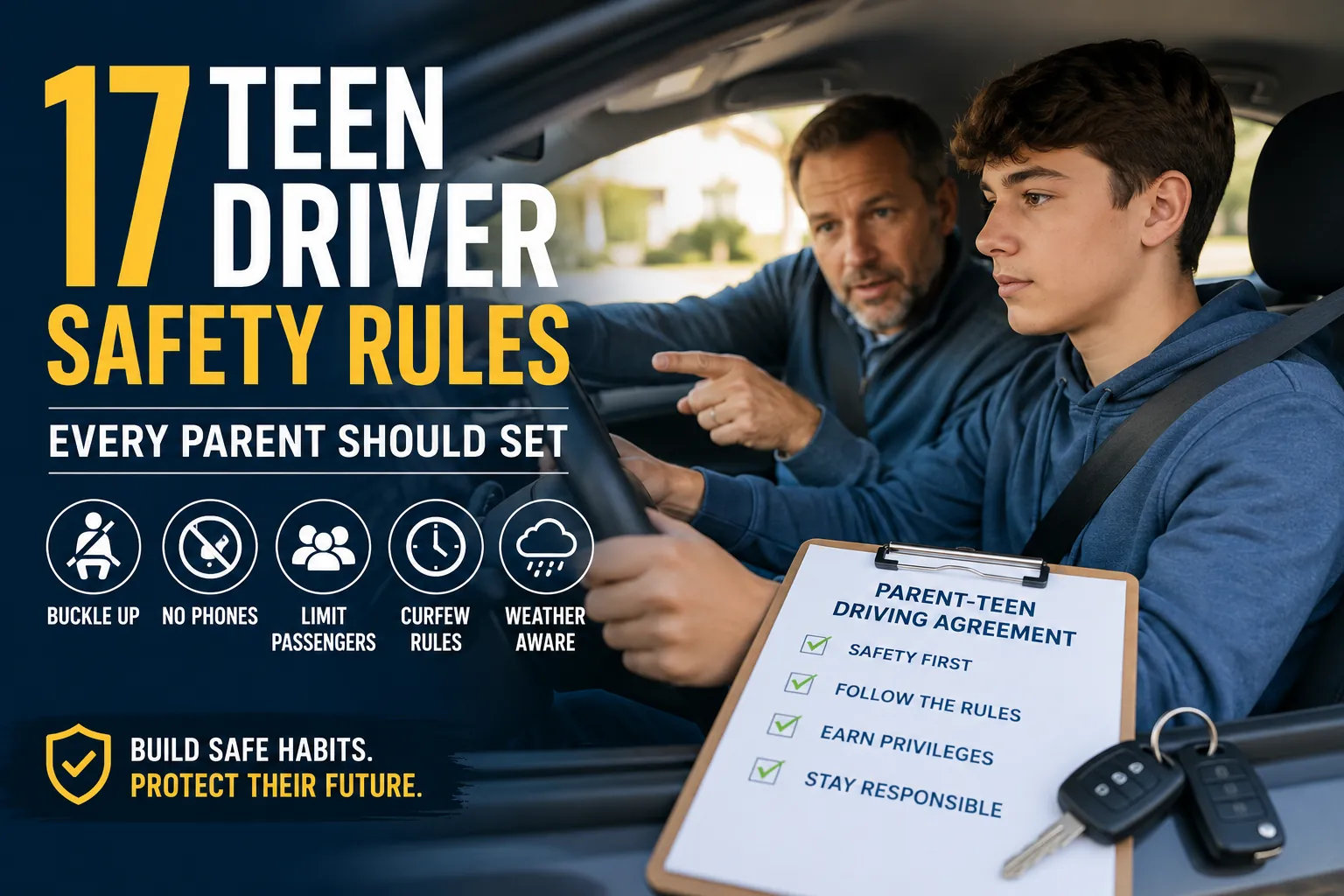
17. Sign a Written Parent-Teen Driving Agreement
Verbal rules get forgotten or reinterpreted under pressure. The rule: both parent and teen sign a written agreement covering curfews, passenger limits, and specific consequences before independent driving starts, and you revisit it every six months to ease restrictions as trust is earned.
How Do Graduated Driver Licensing Laws Differ by State?
GDL laws differ by state on four points: how long a permit must be held, how many supervised hours are required, nighttime driving cutoffs, and passenger limits.
Important: GDL requirements vary by state and may change over time. Always verify the latest rules with your state’s official licensing authority before relying on specific permit, curfew, or passenger restrictions.
| State | Permit Holding Period | Supervised Driving Requirement | Nighttime Driving Restriction* | Passenger Restriction* | Official Licensing Authority |
| Ohio (BMV) | Minimum 6 months | 50 hours total, including 10 nighttime hours | Midnight–6:00 AM; after 12 months licensed (under 18), changes to 1:00 AM–5:00 AM | Max 1 non-family passenger under 21 during the first 12 months | Ohio Bureau of Motor Vehicles (BMV) |
| Massachusetts (RMV) | Minimum 6 months with a clean driving record | 40 hours supervised, or 30 hours with an approved Driver Education parent module | Midnight–5:00 AM | No passengers under 18 (except immediate family) for the first 6 months after JOL | Massachusetts Registry of Motor Vehicles (RMV) |
| South Carolina (SCDMV) | Minimum 180 days (6 months) | 40 hours total, including 10 nighttime hours | 6:00 PM–6:00 AM (Standard Time) or 8:00 PM–6:00 AM (Daylight Saving Time) unless accompanied by a licensed adult | Max 2 non-family passengers under 21 (subject to state exceptions) | South Carolina Department of Motor Vehicles (SCDMV) |
| Louisiana (OMV) | Minimum 180 days | 50 hours total, including 15 nighttime hours | 11:00 PM–5:00 AM (Sun–Thu) and Midnight–5:00 AM (Fri–Sat), unless an exception applies | Max 1 passenger under 21 between 6:00 PM and 5:00 AM, unless immediate family | Louisiana Office of Motor Vehicles (OMV) / ExpressLane |
| Washington (DOL) | Minimum 6 months | 50 hours total, including 10 nighttime hours | 1:00 AM–5:00 AM | First 6 months: no passengers under 20 (except immediate family); months 7–12: up to 3 passengers under 20 | Washington State Department of Licensing (DOL) |
See the full breakdown on this site’s state pages: Ohio driving requirements, Massachusetts driving requirements, South Carolina driving requirements, Louisiana driving requirements, and Washington driving requirements.
How Do NHTSA, CHOP, and Other Safety Groups’ Recommended Rules Compare?
Government agencies, hospitals, and insurers largely agree on the core rules, though emphasis differs slightly by source.
| Organization | Strongest Emphasis | Unique Recommendation |
| NHTSA | Seat belts, impaired driving | State-by-state GDL law lookup tool |
| CHOP | Peer passenger limits | Data-driven passenger risk multipliers |
| HealthyChildren.org | Parent-teen communication | Modeling safe behavior as a parent |
| Liberty Mutual / California Casualty | Written agreements | Insurance discounts tied to safe-driving apps |
How Can Parents Enforce These Rules Without Damaging the Relationship?
Parents enforce these rules most effectively through consistency and by modeling the same behavior they expect from their teen, not through strictness alone.
You are your teen’s first driving instructor, long before they hold a permit. If you check your phone at red lights or tailgate slower drivers, your teen learns that from you before they ever get behind the wheel themselves. Use missteps as coaching moments rather than automatic punishment, unless there was a clear, deliberate safety violation. Driver-monitoring apps and built-in vehicle safety features like speed limiters and seat belt reminders can support these rules, but frame them to your teen as a safety tool, not surveillance.
What Should Parents Do Next?
Pair household rules with professional instruction. A certified driving school reinforces defensive driving, hazard recognition, and parking skills that are hard to teach from the passenger seat alone.
843LetsDrive Driving School in Summerville, South Carolina offers structured teen lessons that reinforce these rules in real driving conditions.
CMSC Driving School in West Boylston, Massachusetts pairs classroom instruction with supervised road practice.
Safe Pass Driving School in Ohio covers defensive driving fundamentals for teen and adult learners alike.
For a checklist on vetting any school before enrolling, see our guide on the signs of a good driving school.
Frequently Asked Questions
What rules should parents set for teen drivers?
Start with the non-negotiables: seat belts every time, no phone use while driving, zero tolerance for alcohol or drugs, a peer passenger limit, and an early nighttime curfew. Add speed limit enforcement and a written driving agreement once those core habits are established.
Why is night driving especially dangerous for teens?
Nighttime combines reduced visibility, headlight glare, fatigue, and a higher share of impaired drivers on the road, all at once. New drivers haven’t yet built the experience to judge distances and spot hazards quickly in low light, which makes crashes more likely.
How many passengers should a teen driver be allowed?
Most safety organizations recommend zero peer passengers for the first 6 to 12 months of solo driving. After that, cap it at one non-family passenger, since each additional peer passenger measurably raises crash risk. Check your state’s GDL law too, since several states set a legal passenger limit that matches or exceeds this recommendation.
Should parents create a written driving agreement?
Yes. A signed agreement removes ambiguity about curfews, passenger limits, and consequences, and it holds both the parent and teen accountable. Revisit and adjust it every six months as your teen earns more independence, and treat eased restrictions as an earned reward rather than an automatic one.