Massachusetts RMV Road Test 2026: Score Sheet, Checklist & Automatic Fails Explained
The Massachusetts road test score sheet fails more first-time drivers over small, avoidable mistakes than over dangerous driving. Updated July 2026: the RMV grades every Class D applicant against a standardized two-part scoring form — maneuver errors on one side, critical automatic fails on the other.
Most drivers who fail don’t lose control of the car; they lose points on details like an unreleased parking brake or a missed shoulder check.
In this guide, you’ll find:
- A full breakdown of what the RMV score sheet actually grades
- Every required maneuver, explained step by step, plus what to expect by city
- The exact actions that trigger an automatic fail
The Massachusetts Class D road test is the RMV’s official 15–20 minute behind-the-wheel evaluation, conducted by a certified examiner who checks off errors on a standardized score sheet rather than awarding points. It covers vehicle control, required parking maneuvers, and traffic-law compliance, and it’s administered at RMV service centers statewide — from Boston to Worcester to Springfield — under the same scoring rules.
Quick Answer
- The RMV examiner grades you across two sections: maneuver errors (parallel parking, hill parking, the 50-foot backup, three-point turn) and critical automatic fails (curb strikes, rolling stops, examiner intervention).
- Racking up 3 or more checks in the standard scoring sections fails the test — even without a single critical error.
- Your vehicle must have a center-console parking brake the examiner can reach from the passenger seat, or the RMV rejects the car before the test starts.
- A failed test costs $35 to reschedule, and Massachusetts requires a two-week wait before retesting.
What Is the Massachusetts Road Test Score Sheet and Who Needs to Take It?
The Massachusetts road test score sheet is the official RMV grading document examiners use to evaluate every Class D (regular license) and Class M (motorcycle) applicant during the behind-the-wheel test. Anyone applying for a first-time Massachusetts driver’s license — teens with a learner’s permit and adult first-time applicants alike — is graded against this same standardized sheet.
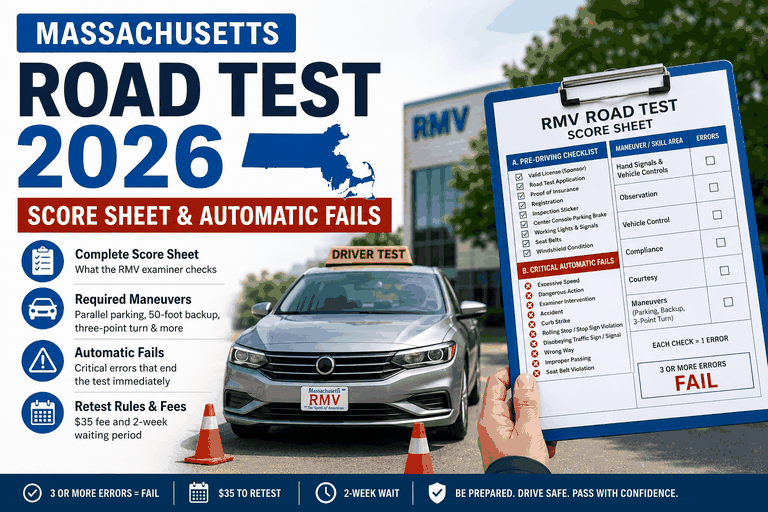
The sheet is split into two parts. Section A covers the Pre-Driving Checklist, which can fail you before the car even moves. Section B covers Critical Errors, which end the test immediately if you commit even one. Between those two sections sits the bulk of the grading: maneuver execution and general operational skill, where checks accumulate toward a numeric fail threshold rather than an instant one.
What Do You Need Before You Start?
Before you can even begin driving, the examiner runs through a pre-test checklist. Missing any of these items gets your test rejected on the spot — no refund, no partial credit:
- A licensed sponsor, at least 21 years old, with a minimum of one year of driving experience and their physical plastic license (digital copies or phone photos are not accepted)
- Your completed Road Test Application
- Valid proof of insurance, current registration, and a valid inspection sticker for the test vehicle
- A vehicle with a center-console parking brake that’s unobstructed and reachable by the examiner from the passenger seat — electronic dash buttons or foot-pedal-only brakes are grounds for rejection
- Working headlights, brake lights, turn signals, horn, windshield wipers, and seat belts
- A windshield free of cracks or debris that would obstruct the examiner’s view
If your own car doesn’t meet these requirements, most Massachusetts driving schools — including CMSC Driving School in West Boylston — offer a car-and-instructor road test rental for exactly this reason.
How Is the Massachusetts Road Test Score Sheet Graded?
The Massachusetts road test isn’t scored like a video game with points added up — the examiner checks off errors under specific maneuver and skill categories, and three or more checks across the standard scoring sections fails the test, separate from any automatic fail. The score sheet groups your performance into a few core competencies:
- Hand Signals & Vehicle Controls — Before driving, you’ll be asked to demonstrate the three hand signals (left turn, right turn, slow/stop) and show you know how to operate headlights, hazards, and windshield wipers.
- Observation — Mirror checks every few seconds, visible shoulder checks before every lane change, and clear head turns at crosswalks and intersections.
- Vehicle Control — Smooth acceleration and braking, steady steering through turns, and correct positioning in your lane.
- Compliance — Full stops behind the white line, obeying “No Turn on Red” signs, and following posted speed limits.
- Courtesy — Signaling early (Massachusetts law requires signaling at least 5 seconds before a lane change or pulling from a curb), yielding to pedestrians, and communicating your intentions clearly to the examiner and other drivers.
Errors in any of these categories add checks toward your total. Stack up three, and the test ends in a fail — even if you never commit a single critical error.
What Maneuvers Are on the Massachusetts Road Test?
Every Massachusetts road test includes the same core set of required maneuvers. Practicing these until they’re automatic is the single highest-leverage thing you can do before test day.
| Maneuver | What the Examiner Wants to See |
| Parallel Parking | Signal before starting, head check over your shoulder while backing, and finish within 12 inches of the curb using no more than two corrections. |
| 50-Foot Straight Backup | Reverse in a straight line for approximately 50 feet without drifting into the road or clipping the curb — physically turn your head and torso to look out the rear window instead of relying on mirrors or a backup camera. |
| Hill Parking | Know your wheel direction by grade: uphill against a curb → wheels turned outward (left); downhill, or any hill without a curb → wheels turned inward (right). Set the parking brake every time. |
| Three-Point Turn (K-Turn) | Signal before each direction change, check your blind spot every time you shift, and complete the turn without touching a curb — all within the width of the road. |
The Emergency Brake Mistake
This is the single most common point-loss on the Massachusetts road test: drivers correctly set the parking brake for hill parking, then forget to release it before continuing the drive. Examiners watch for this specifically, and it’s an easy, avoidable deduction — make releasing the brake part of your muscle memory before you pull away.
What Does the Massachusetts Road Test Look Like by City?
RMV routes vary by location, and knowing your local test area’s quirks helps you practice smarter, not just longer.
Boston, Watertown & Gloucester — Rotary-Heavy Routes
These RMV areas favor rotaries. Yield to cars already in the circle, pick your lane before you enter, and signal clearly as you exit. Rushing a rotary entry or forgetting to signal out is a frequent deduction here.
Worcester & Pittsfield — Steep-Grade Routes
Expect real hills on these routes, not gentle inclines. Practice hill parking on an actual grade — wheel direction only becomes automatic with repetition, and examiners in these areas test it deliberately.
Cambridge & Salem — Narrow Two-Way Streets
These loops squeeze between parked cars on both sides. Maintain steady lane position, slow down proactively, and expect tighter margins on your 50-foot backup and three-point turn.
Whatever your test location, try practicing at your actual appointment time — morning rush, midday, and evening traffic each feel noticeably different behind the wheel.
What Are the Automatic Fails on the Massachusetts Road Test?
Section B of the official RMV score sheet lists Critical Errors — commit even one, and the test ends immediately regardless of how well the rest of the drive went. If this happens, the examiner directs you back to the RMV facility, and you’ll need to pay $35 to reschedule.
| Automatic Fail | What It Looks Like in Practice |
| Examiner or Sponsor Intervention | The examiner has to grab the wheel, hit their own brake, or shout a warning to prevent an accident. |
| Striking a Curb or Object | Driving up onto a curb, or hitting a cone, sign, or another vehicle. (Lightly grazing a curb during parallel parking may only be a deduction — actually mounting it is an automatic fail.) |
| Rolling Stops | Creeping past a stop line before stopping, or slowing to 1–2 mph without fully stopping counts as running the stop. |
| Traffic Law Violations | Running a red light, ignoring “No Turn on Red,” or speeding — especially over 30 mph in a thickly settled residential area or over 20 mph in a school zone. |
| Failure to Yield Right-of-Way | Cutting off an oncoming car during a left turn, or not yielding to a pedestrian in a crosswalk. |
| Dangerous or Uncontrolled Driving | Weaving out of your lane, tailgating, changing lanes inside an intersection, or driving in a way that forces another driver to brake hard to avoid you. |
What Are the Most Common Mistakes to Avoid?
- Turning into the wrong lane. Right and left turns must land you in the same lane you turned from — this is one of the most frequently deducted errors on the Massachusetts test.
- Under-exaggerating mirror and shoulder checks. Examiners can’t always see subtle eye movement — turn your whole head visibly when checking blind spots.
- Forgetting to release the parking brake after hill parking (covered above) — one of the most common instant deductions.
- Relying on the backup camera instead of physically turning to look during the 50-foot backup.
- Not signaling long enough — Massachusetts requires at least 5 seconds of signal before changing lanes or pulling from a curb.
- Arriving with an unsafe or non-compliant vehicle — a cracked windshield or inaccessible parking brake can end your test before it starts.
What Happens After Your Massachusetts Road Test?
If you pass, the examiner issues a temporary license on the spot, valid until your permanent laminated license arrives by mail. You’re licensed to drive immediately — no waiting period.
If you fail, you’re not alone — most applicants pass on a second attempt. Massachusetts requires a two-week minimum wait before retesting, and you’ll need to pay the $35 rescheduling fee, bring a licensed sponsor again, and re-verify your vehicle meets all requirements. Ask your instructor or sponsor for specific feedback on what was checked on your score sheet so you can target that exact weakness before your next attempt.
For a broader look at scheduling, permit requirements, and the full test-day process, see our complete Massachusetts driving test overview. If you still need permit-test prep first, our Massachusetts permit test practice guide covers the written exam in detail. Not sure your car qualifies? JMC Driving School in Waltham can confirm vehicle eligibility or provide one for test day.
Massachusetts Road Test FAQ
How long does the Massachusetts road test take? Most Massachusetts RMV road tests run about 15–20 minutes and cover everyday maneuvers — turns, lane changes, stops, and intersections — plus one parking or backing maneuver like parallel parking or hill parking.
What mistakes cause an automatic fail on the Massachusetts road test? Critical errors end the test instantly: the examiner grabbing the wheel or braking, running a stop sign or red light, dangerous speeding, striking a curb or object, or failing to yield to a pedestrian. Smaller deductions also add up separately.
What are the vehicle requirements for the Massachusetts RMV road test? Your car needs current registration, insurance, and an inspection sticker, plus working lights, horn, wipers, and seat belts. Most importantly, it needs a center-console parking brake the examiner can physically reach — dash-button or foot-pedal-only brakes get the vehicle rejected.
What’s on the Massachusetts RMV road test checklist? The RMV checklist covers your sponsor’s credentials, completed application, vehicle paperwork, and safety equipment — then the drive itself: parallel parking, a 50-foot backup, hill parking, a three-point turn, and general observation and control skills.
How do you get the Massachusetts road test application? The Road Test Application is available through the RMV’s official site at mass.gov/rmv or from your driving school if you completed a certified course. It must be filled out and brought with you, along with your permit and sponsor’s license, on test day.
How do you schedule a Massachusetts RMV road test appointment? Road test appointments are booked directly through the RMV — walk-ins aren’t accepted. Book early, since availability varies by location, and confirm your test center’s specific address and hours ahead of time.
Can you retake the Massachusetts road test if you fail? Yes. Massachusetts requires a minimum two-week wait before rescheduling, along with a $35 fee. You’ll need a licensed sponsor and a compliant vehicle again, just like your first attempt.
What is the Massachusetts Class D road test? The Class D road test is the RMV’s standard behind-the-wheel evaluation for a regular driver’s license. It’s a 15–20 minute drive graded on a standardized score sheet covering maneuvers, vehicle control, and traffic-law compliance.
Related guides on this site: