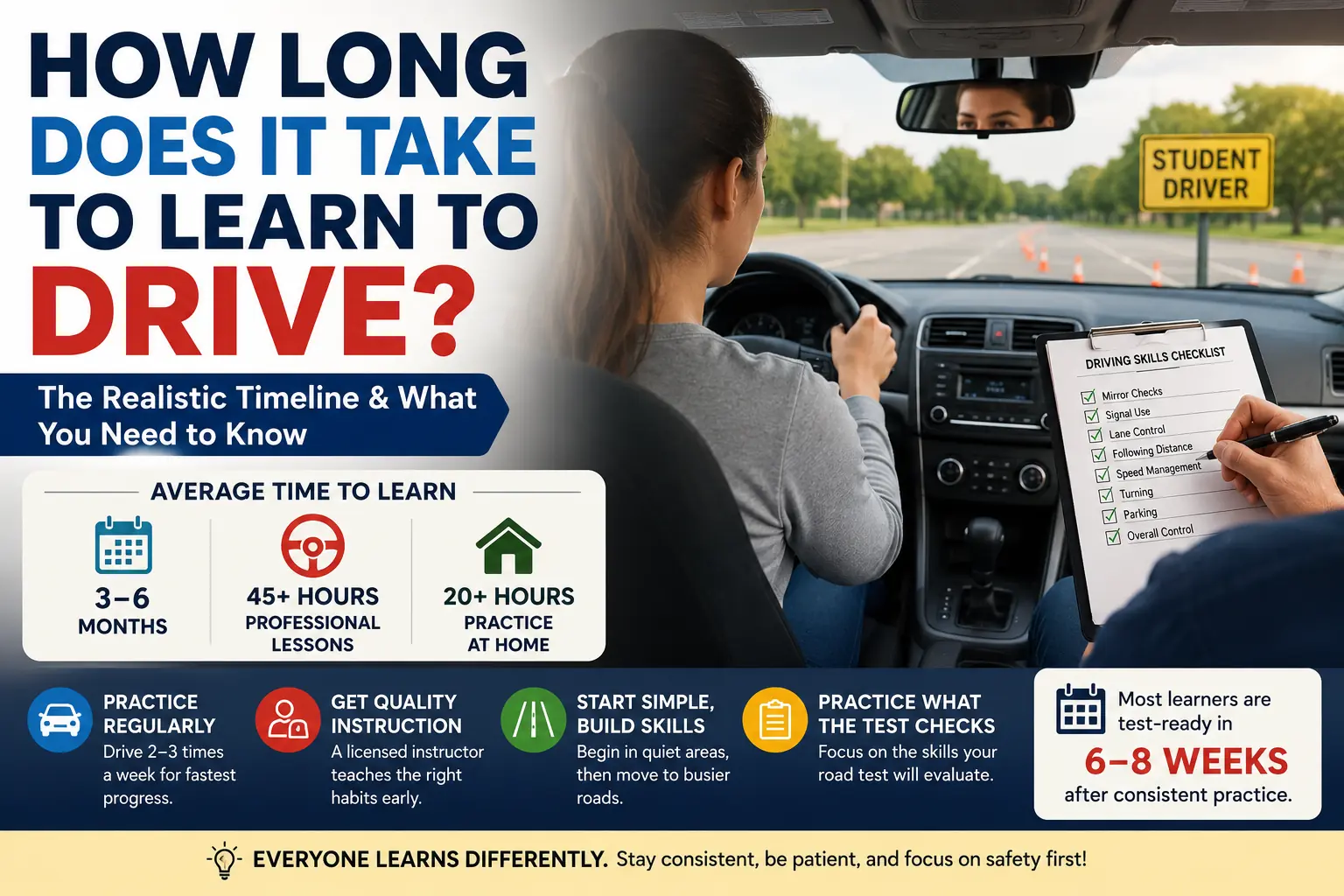
How Long Does It Really Take to Learn to Drive?
How Long Does It Take to Learn to Drive?
Most learners need 40 to 60 hours of practice over 3 to 6 months before they’re ready for a road test, though the exact timeline depends on age, vehicle type, and how often you practice.
Some people cut that in half with daily lessons; others stretch it across a full year with occasional weekend practice. Updated July 2026.
In this guide, you’ll find:
How Long Does It Take to Learn to Drive on Average?
Most learners reach test-ready confidence after 40 to 60 total hours behind the wheel, spread across roughly 3 to 6 months. That total usually blends professional instruction with supervised private practice — very few people become confident drivers from lessons alone.
Teens with a learner’s permit tend to land in the middle of that range, while adults picking up driving for the first time often need slightly more seat time to unlearn hesitation and build muscle memory. The number that matters more than total hours is consistency: three 30-minute sessions a week beat one 2-hour session every other weekend.
How Many Practice Hours Do You Need Before a Driving Test?
| Practice Type ↕ | Typical Hours ↕ | Notes ↕ |
|---|---|---|
| Professional lessons | 15–20 hours | Covers test maneuvers directly |
| Supervised private practice | 20–40 hours | Builds comfort in varied conditions |
| Combined total | 40–60 hours | Most common range across driving programs |
Tap a column header to sort. Figures are general industry estimates, not site-specific data — confirm current pricing with any school directly.
How Many Hours on Average Does It Take to Learn to Drive in the US?
US learners average close to 45 hours of combined instruction and practice before their first road test attempt, based on figures commonly cited across driving programs nationwide. That average shifts by state depending on minimum required permit hours and whether formal driver’s education is mandatory.
Treat 45 hours as a floor, not a target. Extra practice on your specific weak points — parking, merging, night driving — matters more than hitting a round number.
What Factors Affect How Fast You Learn to Drive?
A few variables consistently shift someone from the fast end of the range to the slow end:
Is It Harder to Learn Manual or Automatic?
Yes — automatic is faster to learn for most people, typically shaving several hours off the total because there’s no clutch control or gear timing to master.
- No clutch or gear timing to master
- Faster route to test-ready confidence
- Fewer stall-related setbacks early on
- Extra hours needed for clutch control & hill starts
- More low-speed practice before traffic
- Added flexibility once mastered
If your goal is passing the test as quickly as possible, automatic is the more time-efficient choice. Manual is worth the extra hours only if you want the added flexibility later.
How Long Does It Take to Learn to Drive as an Adult?
Adult learners typically need a similar 40–60 hour range as teens, but often compress it into fewer calendar months because they can schedule lessons more flexibly. The bigger hurdle for most adults is confidence rather than skill, since years as a passenger already build a working knowledge of traffic rules.
Programs built around returning or first-time adult drivers focus less on classroom theory and more on hands-on practice — one reason an adult abbreviated course often moves faster than a standard teen curriculum.
Can You Learn to Drive in 15 Days?
Learning in 15 days generally requires daily 1–2 hour practice sessions plus some prior comfort around vehicles. Most people who manage this aren’t needing fewer total hours; they’re consolidating hours that would normally spread across months into a tight daily schedule. If your timeline is tight, prioritize consistency over cramming — several short daily sessions build skill faster and more safely than one long weekend push.
A Week-by-Week Learning Timeline
This maps roughly to the 40–60 hour total most learners land on, assuming 4–5 hours of combined practice per week.
How Can You Learn to Drive Faster?
Structured lesson plans consistently help learners pass the test faster than unguided practice alone, mainly because they front-load the maneuvers examiners weight most heavily.
What Should You Practice Before Your Driving Test?
Most instructors recommend confirming comfort with these five areas — they make up the bulk of point deductions on most road tests:
Structured student driving lessons typically build toward this exact checklist rather than leaving it to chance.
Frequently Asked Questions
Most learners reach test-ready confidence in an automatic within 30 to 40 hours, a bit faster than manual since there’s no clutch control to practice. Timelines still shift with practice frequency and comfort level, but automatic typically shortens the learning curve by several hours compared with a manual car.
Most US learners need around 40 to 60 hours of combined instruction and practice, spread across 3 to 6 months before their first test attempt. Exact requirements vary by state, since some mandate a minimum number of supervised hours before you can take a road test.
Including the licensing steps, most learners spend 3 to 6 months practicing before testing, plus permit and scheduling wait times that vary by state. Total time to license usually lands closer to 4 to 8 months once paperwork and test scheduling are factored into the timeline.
Most figures land between 40 and 60 total hours, combining professional lessons with supervised private practice at home or with family. Fewer hours are typically needed with frequent, short sessions rather than occasional long ones spread far apart.
It’s possible with daily practice sessions, but it compresses the same total hours into a shorter window rather than reducing them. Consistency matters more than speed here — several short daily sessions build skill faster and more safely than one long weekend push.
Most learners attempt freeway driving only after 15 to 20 hours of lower-speed practice, since merging and lane changes require baseline comfort first. Once that foundation is set, most people adjust to freeway conditions within just a few dedicated practice sessions.
What to Do Next
Ready to Start Your Driving Lessons?
Compare real driving schools near you, see current pricing, and find the course that matches your timeline — teen, adult, or fast-track.