How to Merge Onto a Highway for the First Time: A Beginner’s Guide
Merging onto a highway comes down to matching the speed of traffic before you run out of ramp — most first-timers panic and slow down instead. Whether you call it a highway, freeway, or expressway, the mechanics are the same: the entrance ramp exists so you can accelerate, not so you can wait for a gap to appear.
Quick Answer: The 5-Step Merge Sequence
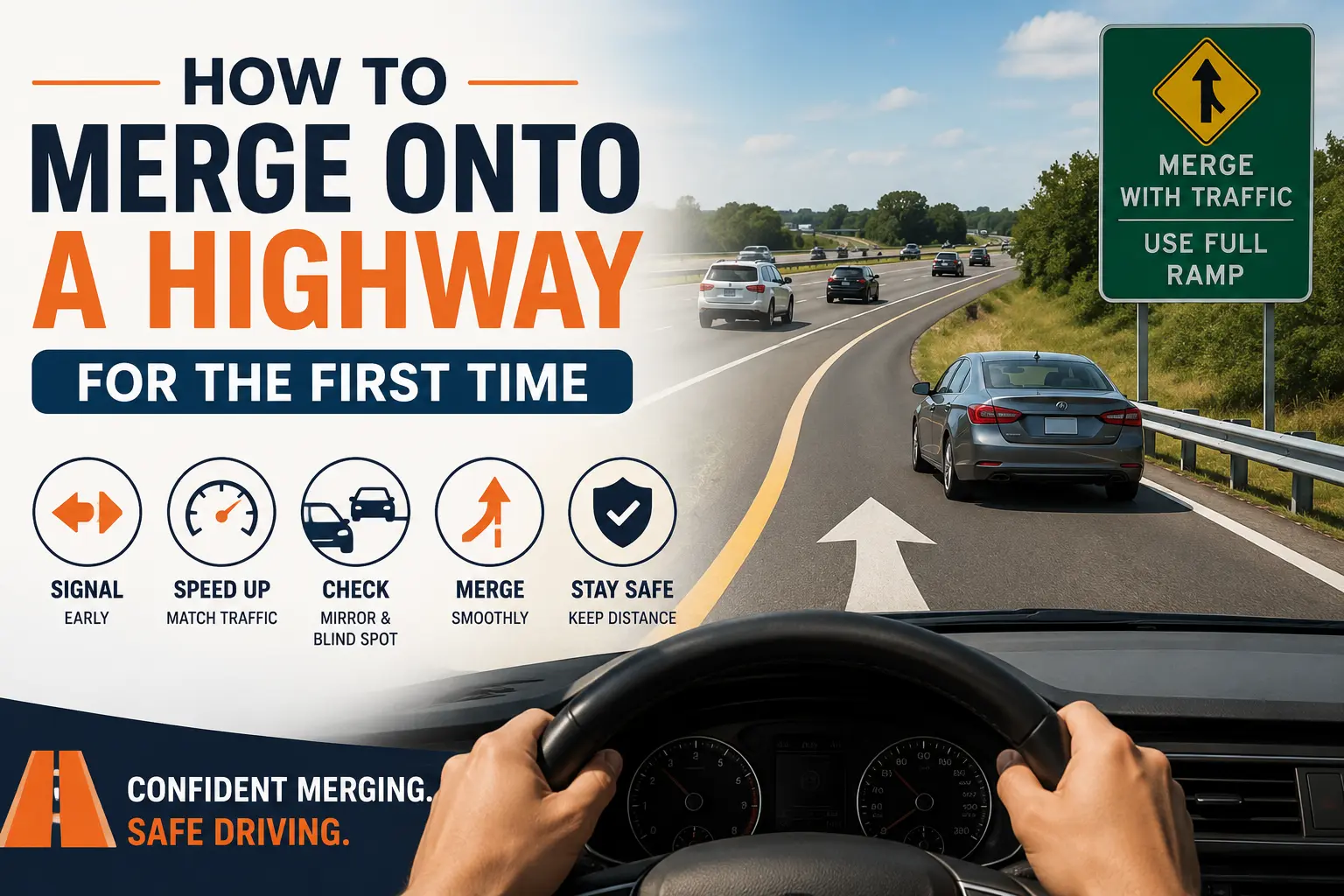
- Signal as soon as you’re on the straight part of the ramp
- Use the full acceleration lane to match highway traffic speed
- Check your mirror, then your blind spot, for a safe gap
- Merge with a smooth, steady steering input — no sudden jerks
- Cancel your signal and settle into a safe following distance
What Are the Steps to Merge Onto a Highway Safely?
Merging safely comes down to five things done in sequence: signal, accelerate, scan, merge, and adjust. Skipping the accelerate step is what causes most of the anxiety and most of the near-misses — everything else follows from getting your speed right first.
Signal as Soon as You’re on the Ramp
Turn on your left turn signal as soon as you’re on the straight portion of the entrance ramp, well before you reach the highway lanes. This gives drivers already on the highway time to notice you and, if they’re able to, shift over a lane to give you room.
Use the Full Ramp to Accelerate
Your only job on the ramp is to reach highway speed — usually somewhere in the 55–65 mph range, depending on the posted limit. Press the gas earlier and more firmly than feels natural; a slow, timid approach is the single most common reason new drivers struggle to merge.
Check Your Mirrors, Then Your Blind Spot
Once you’re near highway speed, check your side mirror, then glance quickly over your shoulder to clear your blind spot. You’re looking for a gap of roughly 3 to 4 seconds between you and the car that would be behind you in the lane.
Merge With a Smooth, Steady Steering Input
Steer gently into the gap — no sudden jerks. Stay inside the ramp’s solid white line until it turns to a dashed line; that’s your signal that it’s safe to cross into the travel lane.
Cancel Your Signal and Settle Into Traffic
Once you’re in the lane, turn off your signal and adjust your speed to keep a safe following distance from the car ahead. Give yourself a few seconds to settle before making your next lane change.
What’s the Biggest Mistake New Drivers Make When Merging?
The biggest mistake is treating the ramp as a place to stop and wait rather than a place to accelerate. Highway traffic is moving at 55-plus mph, and a car entering at 20 mph creates a dangerous speed mismatch that forces everyone around it to react.
Stopping or Slowing Down on the Ramp
One of the simplest rules for merging onto a highway is this: if you slow down or stop instead of building speed, you remove your own ability to find a safe gap — you become the hazard other drivers have to work around.
What Speed Should You Merge Onto the Highway At?
Match the speed of the traffic already on the highway or expressway, not the speed limit on the ramp itself. If highway traffic is moving at 62 mph, that’s your target — not 55, and not whatever felt comfortable on the on-ramp. Watch the flow of cars in the lane you’re merging into and adjust your acceleration to land right in that range by the time the ramp ends.
How Do You Merge Onto a Highway in Heavy Traffic?
In heavy traffic, gaps close faster and drivers are less able to shift lanes to accommodate you, so the accelerate-and-commit approach matters even more. Pick a gap early, hold your speed steady, and merge decisively rather than second-guessing your spot halfway through. The lane you’re entering has the right of way, but that doesn’t mean traffic will stop for you — it’s your job to find the opening and take it.
How Can Nervous Beginners Build Confidence Merging?
Practice During Quiet Hours
Mid-morning or early afternoon traffic gives you more room for error than rush hour.
Look Up the Road
Watching traffic further out helps you anticipate gaps instead of reacting late.
Treat a Full Stop as a Last Resort
Only stop if highway traffic is completely stopped — treat the ramp like a yield, not your default plan.
Expect to Take Your Gap, Not Be Invited
Drivers on the highway aren’t required to let you in — your job is to find the opening and take it smoothly.
Highway Merging FAQ
Match the speed of the traffic already in the lane you’re entering, typically 55 to 65 mph depending on the highway. Watch the cars around you rather than relying on the posted ramp speed alone.
Traffic already on the highway has the right of way. That means it’s your job to find a safe gap and merge into it — not to expect other drivers to slow down or move over for you.
Keep building speed instead of slowing down, and hold your line until a gap opens rather than stopping. If the ramp genuinely runs out and traffic is too dense, treat it as a yield rather than a full stop, and merge as soon as the smallest safe gap appears.
The core rule is to match highway speed before you merge, using the entire acceleration lane rather than waiting for a gap to appear. Signal early, check your mirror and blind spot, then merge only where the ramp’s line turns to a dashed line.
Give yourself extra room by practicing during quieter traffic first, and remind yourself that hesitation is riskier than committing. Focus on matching speed and holding your line rather than watching for someone to wave you in — nobody is required to stop for you.
Aim for about 3 to 4 seconds of following distance once you’re settled into the lane. This gives you enough room to react if traffic ahead slows down suddenly.
Signal as soon as you’re on the straight part of the entrance ramp, before you start accelerating toward highway speed. Early signaling gives other drivers the most time to notice and react.
What to Do Next
Explore More on driving-schoolnear.me
Note: Blog index URL not yet confirmed — swap the “#” once you send the live slug.Ready to Build Real Highway Confidence?
Reading about merging only gets you so far — practicing with a licensed instructor is the fastest way to make it feel automatic before your road test.