Nervous About Merging Onto the Highway? Here’s the 5-Step Process That Works
Most new drivers assume merging too fast is the danger when learning how to merge onto a highway — it’s actually the opposite. Merging too slowly is the most common cause of highway merge accidents, because it forces other drivers already in the lane to brake or swerve around you. Updated July 2026.
📋 In This Guide, You’ll Find
- The 5-step merge process driving instructors teach
- A decision tree for light traffic, heavy traffic, and no available gap
- Common mistakes beginners make on the ramp, and what to do if merge anxiety is holding you back
How Do You Merge Onto a Highway in 5 Steps?
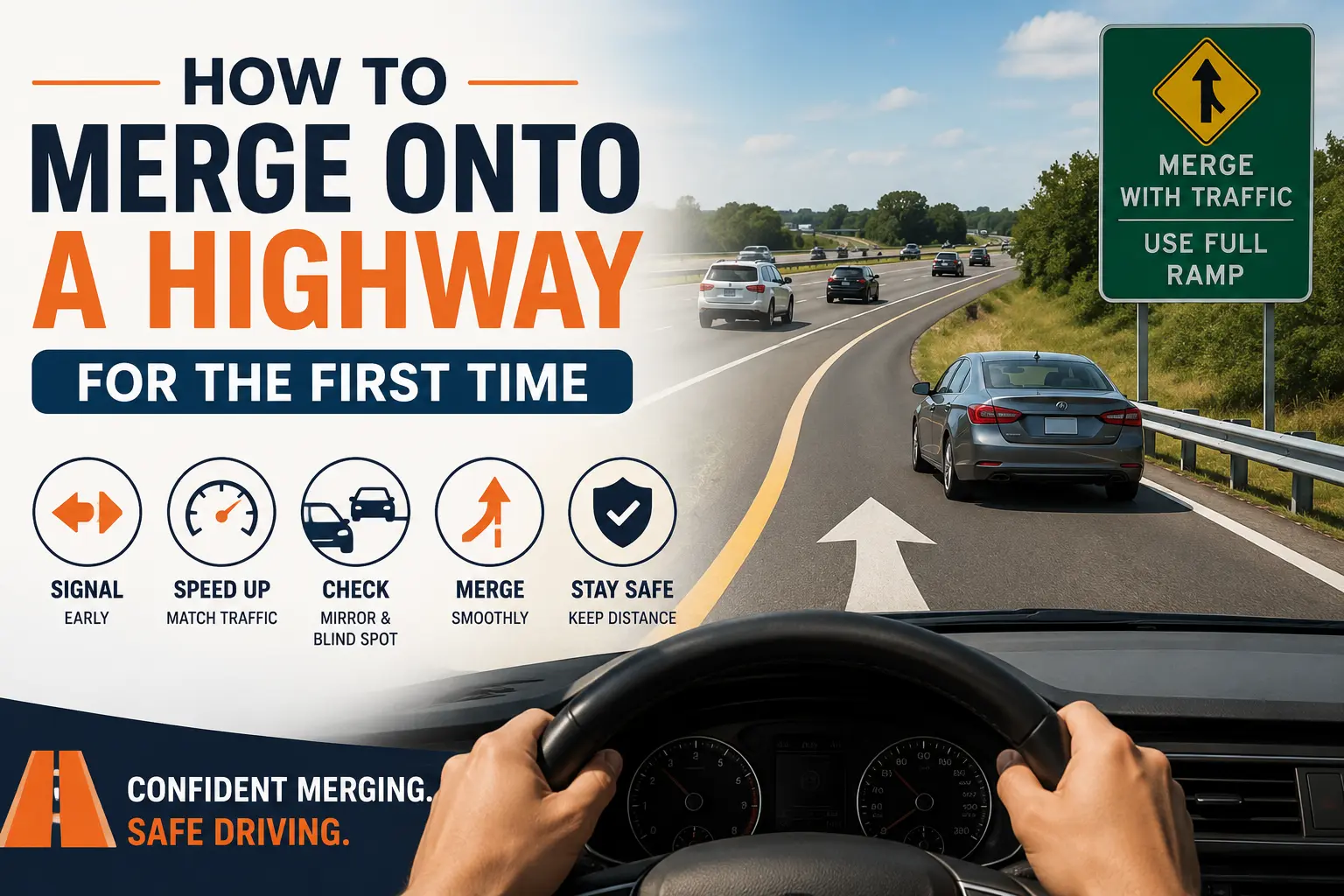
Merging onto a highway safely comes down to five steps done in order, without stopping: signal early, accelerate to match traffic speed, scan your mirrors and blind spot, find a safe gap, and merge smoothly. Skipping the order — especially rushing the acceleration step — is what turns a routine merge into a dangerous one.
Signal Early
Turn on your left turn signal as soon as you enter the straight part of the entrance ramp — not right before you merge. This gives drivers already on the highway (or expressway, depending on your state) several seconds to notice you and adjust, rather than reacting at the last second. Signaling early is also what separates a confident-looking merge from a hesitant one, which matters because other drivers respond better to predictable movement.
Accelerate to Match Traffic Speed
Use the entire acceleration lane to build your speed — your goal is to be at or near the speed of highway traffic (for example, 55–65 mph) before you reach the end of the lane, not after. A short burst of speed here feels aggressive to new drivers, but it’s the opposite of risky: entering a 65 mph lane at 40 mph is what causes rear-end collisions. This is exactly the kind of real-world skill instructors at schools like NOLA Driving Institute in Louisiana build into behind-the-wheel lessons — it’s not something most new drivers know instinctively. Treat the acceleration lane as a runway, not a waiting area.
Scan Your Mirrors and Blind Spot
Check your side mirror, then take a quick glance over your shoulder into your blind spot — mirrors alone won’t show you a car sitting just behind your rear bumper. This should take under a second; a longer look means you’re not watching the road ahead. Do this scan while you’re still accelerating, not after you’ve already reached the end of the ramp.
Find Your Gap
Look for a gap of roughly 3–4 seconds of following distance in the right lane. You don’t need a huge opening — you need one that’s growing, not shrinking, relative to your speed. If you’re matching traffic speed from Step 2, gaps that looked too tight at 40 mph will look normal at 60 mph.
Merge Smoothly and Adjust
Steer gently into the gap — don’t cross a solid white line if one is still present on the ramp; wait until it turns to a dashed line before moving over. Once you’re in the lane, turn off your signal and adjust your speed to hold a safe following distance from the cars around you.
What Should You Do If Traffic Conditions Change While You’re Merging?
Your approach should shift depending on how busy the highway is — a merge that works in light traffic can be dangerous in heavy traffic, and vice versa. Tap a tab below for the specific approach for your situation.
Accelerate early and merge as soon as you find a comfortable gap. You don’t need to use the full length of the acceleration lane — with fewer cars around, gaps open naturally and you can commit as soon as your speed matches the lane you’re entering.
Use the entire acceleration lane and match speed exactly before committing to a gap. In heavy traffic, gaps open and close fast, so precision matters more than speed of decision — get your speed right first, then commit to the first safe opening.
Ease off slightly and let a gap open behind the car ahead of you. Never stop on the ramp to wait — a small, steady speed reduction is far safer than braking hard or coming to a stop in an active merge lane.
| Situation | What to Do |
|---|---|
| Light traffic | Accelerate early and merge as soon as you find a comfortable gap — no need to use the full ramp |
| Heavy traffic | Use the entire acceleration lane; match speed exactly before committing to a gap |
| No gap appears | Ease off slightly and let a gap open behind the car ahead of you — never stop on the ramp to wait |
What Mistakes Do New Drivers Make When Merging Onto a Highway?
Stopping on the Ramp
Unless highway traffic is completely stopped, stopping on the entrance ramp is one of the most dangerous things you can do — treat a full stop as a last resort, not a strategy.
Merging Under the Speed Limit
Rolling into the highway 15–20 mph slower than traffic forces other drivers to brake for you.
Fixating on the Car Ahead
Watching only the bumper in front of you means you’ll miss the bigger traffic pattern. Keep your eyes up the road.
Assuming Someone Will “Let You In”
Highway traffic has the right of way. Your job is to find the gap and take it — not wait for it to be offered.
Crossing a Solid Line to Force a Merge
If the lane marking is still solid, you’re required to wait until it turns dashed, even if a gap looks tempting.
Is It Normal to Feel Nervous About Merging on a Busy Highway?
Yes — nervousness about merging in heavy or fast-moving traffic is one of the most common anxieties new drivers report, and it fades with repetition, not with waiting for the “right” conditions. A few things that help:
Practice at Low-Traffic Times First
Mid-morning or early afternoon on a weekday has noticeably lighter highway traffic than rush hour, giving you room to build the habit before facing busy conditions.
The Merge Lane Is Yours to Use
It exists specifically for you to enter traffic — you’re not asking for permission, you’re using the infrastructure as designed.
Start With Short, Familiar Stretches
Merging onto a highway you’ll exit within a mile or two builds confidence faster than a long, unfamiliar drive.
Get Supervised Practice Before Going Solo
Structured behind-the-wheel lessons — like those offered at Safe Pass Driving School in Ohio — build merging into a controlled setting with an instructor before you’re doing it alone in heavy traffic.
Frequently Asked Questions
Traffic already on the highway has the right of way, not the merging driver. As you enter, it’s your responsibility to match their speed and find a safe gap yourself — you shouldn’t expect other drivers to slow down, flash their lights, or move over to let you in.
You should be at or very close to the speed of highway traffic — typically 55–65 mph, depending on the posted limit — by the time you reach the end of the acceleration lane. Merging significantly below that speed is one of the leading causes of highway merge accidents, since it forces faster traffic to brake suddenly.
No — you should only stop if highway traffic ahead is completely stopped. Use the full acceleration lane to build speed continuously instead. Stopping on a moving on-ramp removes the space you need to accelerate and puts you at serious risk of being rear-ended by traffic behind you.
Use the entire acceleration lane to match traffic speed exactly before committing to a gap — don’t try to squeeze in early. In heavy traffic, gaps open and close quickly, so stay at a steady speed and commit to the first safe opening rather than waiting for a perfect one.
Ease off your speed slightly so a gap opens up behind the car ahead of you, rather than stopping or braking hard. Staying at a steady, predictable speed makes it far easier for drivers behind you to react and adjust than sudden braking does.
Yes — highway merging is one of the most common sources of anxiety for new drivers, especially in heavy traffic. It typically improves with repeated, low-pressure practice on quieter roads first, rather than waiting until merging feels completely comfortable before trying it.
What to Do Next
Merging is one skill among many that structured lessons cover in more depth than any single guide can. If you’re still building core confidence behind the wheel, start with the basics before tackling highway driving, and check what separates a good driving school from a mediocre one if you’re evaluating instruction options.
Ready to Get Supervised Merging Practice?
Highway merging is easiest to master with an instructor beside you the first few times. NOLA Driving Institute and Safe Pass Driving School both build merging into behind-the-wheel lessons before you’re doing it solo in heavy traffic.