How to Get a Driver’s License as an Adult Who Has Never Driven
By Noah A. | Updated July 2026
Quick Answer
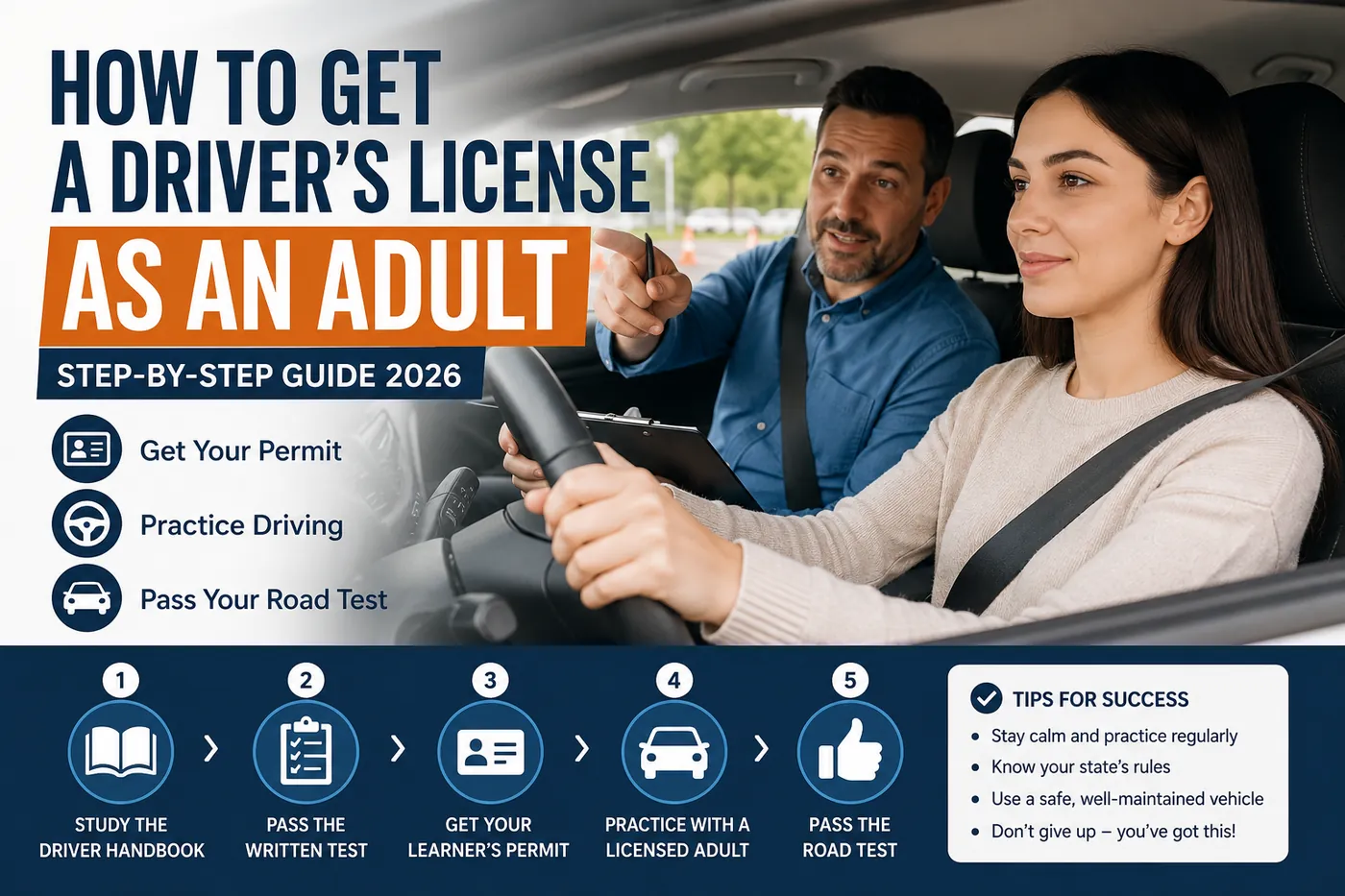
● Study your state’s driver handbook and pass the written knowledge test to get a learner’s permit.
● Gather proof of identity, your Social Security number, and two proofs of residency before you visit the DMV, BMV, or RMV.
● Practice 15 to 30-plus hours with a licensed adult or a professional instructor before scheduling your test.
● Take the road test in a registered, insured vehicle with working headlights, brake lights, and turn signals.
Source: State DMV/BMV/RMV driver handbooks | Updated: July 2026
Getting a driver’s license as an adult who has never driven takes most first-time adult learners between four and eight weeks, from your first visit to the license center to passing the road test. Updated July 2026. Millions of adults learn to drive later in life, and enrolling in structured driving classes often shortens that timeline further, because an instructor already knows what your state’s examiner looks for on test day.
In this guide, you’ll find:
● The exact documents and tests required for an adult learner’s permit
● A practice plan that works whether or not you hire an instructor
● What to expect on road test day, and how the process differs across Ohio, Massachusetts, South Carolina, Louisiana, and Washington
What Documents Do You Need to Get a Learner’s Permit as an Adult?
You need three categories of documents to apply for an adult learner’s permit: proof of identity and age, proof of your Social Security number, and two proofs of state residency. Proof of identity typically means a birth certificate, valid U.S. passport, or permanent resident card. Your Social Security number can be verified with your Social Security card, a W-2, or a pay stub showing the full number. Proof of residency usually requires two documents such as a utility bill, lease agreement, or bank statement showing your current address. Bring originals, not photocopies, since most license centers will not accept copies for identity documents.
How Do You Pass the Written Knowledge Test?
You pass the written knowledge test by studying your state’s official driver handbook, which is free to download from your state’s DMV, BMV, or RMV website. Focus your study time on road signs and traffic signals, right-of-way rules, speed limits and safe following distances, and alcohol and substance laws. Most license centers also require a vision screening on the same visit as the knowledge test. Once you pass both, you receive your learner’s permit and can begin supervised practice driving.
Do Adults Have to Hold a Permit Before Taking the Road Test?
In most states, adults do not face the same permit-holding requirement that applies to teen drivers. Teen learners in many states must hold a permit for six months or longer before testing, but adults 18 and older are often allowed to schedule a road test as soon as they feel ready. A handful of states still require adults to hold a permit for 30 to 60 days before the road test, so check the specific rule for your state before you book an appointment. [VERIFY BEFORE PUBLISH]: confirm current adult permit-holding periods for Ohio, Massachusetts, South Carolina, Louisiana, and Washington against each state’s official DMV/BMV/RMV source.
How Should Adult Beginners Practice Driving?
Adult beginners should practice in a low-pressure setting first, then build up to traffic gradually, whether they learn from a professional instructor or a licensed friend or family member.
Working With a Professional Driving Instructor
A certified driving instructor is often the fastest and least stressful way to learn as an adult. Instructor vehicles typically have a brake pedal on the passenger side for safety, and instructors work with adult learners daily, so they teach without the impatience a family member might bring to the passenger seat. They also know the exact routes and criteria your local examiner uses, which is why many adult learners see one-on-one instruction as worth the cost. If you want an instructor who works around a full-time schedule, look at one-on-one driving instructors for adults in your area.
Practicing With a Licensed Friend or Family Member
If you practice with a licensed adult instead, start in a wide, empty parking lot to work on starting, braking smoothly, turning, and basic parking before moving to public roads. Progress to quiet residential streets before attempting arterial roads, highway merging, or night driving. Choose a passenger who stays calm and encouraging, since a tense passenger makes new drivers more anxious, not less. For a sense of what a first lesson actually covers, see what to expect from your first driving lesson.
How Do You Build Confidence If You’re Nervous About Driving?
You build confidence by practicing in low-stakes settings first and increasing difficulty only after each step feels routine, not by pushing straight into traffic. Driving anxiety is common among adult beginners, and it is usually tied to inexperience rather than a lasting inability to drive safely. Break your practice sessions into short, specific goals, such as ten minutes of smooth stops and starts in a parking lot, before adding turns, then traffic, then highway merging. Many adult learners find that a calm instructor helps more than a familiar passenger, precisely because an instructor does not react visibly to small mistakes. If anxiety persists after several weeks of gradual practice, ask a driving school whether they offer extra sessions focused specifically on confidence-building rather than test preparation.
What Happens on Road Test Day?
On road test day, examiners evaluate your basic vehicle control, your knowledge of traffic rules, and your ability to complete specific maneuvers. You will need your valid learner’s permit, a registered and insured vehicle with working headlights, brake lights, turn signals, and seatbelts, and a licensed adult to drive the car to the test site. Examiners look for smooth acceleration, complete stops behind the limit line, gradual braking, consistent turn-signal use, and blind-spot checks before lane changes. You will also be asked to complete maneuvers such as reversing in a straight line, a three-point turn, and parallel or perpendicular parking.
How Does the Adult Licensing Process Differ by State?
The core steps (permit, practice, road test) are the same everywhere, but permit-holding periods, required practice hours, and fees vary by state, so the fastest path depends on where you live.
| State | Adult Permit Holding Period | Local Resources | Official Source |
| Ohio | [VERIFY BEFORE PUBLISH] | Ohio driving schools; Ohio adult abbreviated course | bmv.ohio.gov |
| Massachusetts | [VERIFY BEFORE PUBLISH] | Massachusetts driving schools | mass.gov/rmv |
| South Carolina | [VERIFY BEFORE PUBLISH] | South Carolina driving schools | scdmv.net |
| Louisiana | [VERIFY BEFORE PUBLISH] | Louisiana driving schools; adult driving schools in Baton Rouge | expresslane.org |
| Washington | [VERIFY BEFORE PUBLISH] | Washington driving schools | dol.wa.gov |
Local resource links:
● Ohio adult abbreviated course
● Massachusetts driving schools
● South Carolina driving schools
● Adult driving schools in Baton Rouge
Contact your state’s licensing authority directly before you book a road test, since holding periods and fees are the figures most likely to change year to year.
How Much Does It Cost and How Long Does It Take?
Getting licensed as an adult beginner typically costs between $300 and $900 or more if you take professional lessons, or as little as $40 to $100 in DMV administrative fees if you practice entirely with a licensed friend or family member’s car. As of July 2026, most adult learners still finish the full process, from first DMV visit to passing the road test, in about four to eight weeks. Professional lessons are the largest variable cost, and packages are usually sold in blocks of hours rather than a single flat rate. If you are comparing instructor pricing, our breakdown of six-hour driving school package pricing shows what that block of instruction typically includes.
| Expense Category | Estimated Cost | What It Covers |
| DMV Permit & Licensing Fees | $30 – $100 | Written knowledge exam, vision test, learner’s permit, and the physical license card after passing. |
| Driving Lessons (largest expense) | $50 – $85/hour, or $300 – $800 per package | 6 to 10 hours of professional behind-the-wheel instruction in a dual-control car. |
| Test Day Vehicle Rental (optional) | $100 – $200 | Hiring a local driving school to provide a DMV-compliant car and drop-off/pickup for your road test. |
Figures above are typical national ranges as of July 2026 and will vary by state and provider. Contact your state DMV and a local driving school directly to confirm current pricing before you budget for lessons.
What Mistakes Do Adult Learners Make Most Often?
Adult learners most often lose time by skipping the handbook, undercounting practice hours, or scheduling the road test before they can comfortably parallel park. Treating the knowledge test as a formality is a common misstep, since many adults fail it on the first try when they skip the handbook entirely. Another frequent mistake is practicing only in empty parking lots and never progressing to highway merging or night driving before test day. Some adult learners also wait to address driving anxiety until test week instead of building confidence gradually over several weeks of practice. A less obvious mistake is assuming every state runs the process identically, when permit-holding periods, required document lists, and even accepted vehicle conditions vary by state and can delay a road test date if you show up unprepared. Booking the road test too early, before you can consistently perform a three-point turn or parallel park without coaching, is one of the most common reasons adult learners fail on the first attempt and lose weeks rescheduling.
Quick Checklist for First-Time Adult Drivers
| Task | Action Required |
| Study | Read your official state driver handbook cover to cover. |
| Apply | Visit the DMV, BMV, or RMV with proof of ID, Social Security number, and residency. |
| Permit | Pass the vision screening and written knowledge test. |
| Practice | Complete 15 to 30-plus hours, moving from parking lots to suburban roads to highways. |
| Exam | Schedule, take, and pass the practical road skills test. |
Frequently Asked Questions
What happens if I don’t get a REAL ID?
Without a REAL ID-compliant license or another accepted form of ID, you will not be able to use it to board domestic flights or enter certain federal facilities. You can still drive with a standard license. Ask your state’s DMV, BMV, or RMV whether your license is already REAL ID-compliant or requires a separate application.
How does an adult get a driver’s license in Ohio?
Adults in Ohio follow the same core steps as other states: pass the written knowledge and vision tests to get a permit, practice with a licensed driver or instructor, then pass the road test. Ohio also offers an adult abbreviated course for learners who want condensed, instructor-led training.
Can you learn to drive without a permit?
No, you need a valid learner’s permit before practicing on public roads in every state this site covers. Practicing without one is illegal and can also delay your eventual road test if you are cited. Get your permit first, then begin supervised practice.
What’s the fastest way to get a driver’s license as an adult?
The fastest route combines studying the handbook before your DMV visit, booking your written test and permit application together, and starting practice immediately once you have your permit. Many adult learners cut weeks off the process by hiring an instructor instead of coordinating a family member’s schedule.
Am I too old to learn to drive?
No, there is no upper age limit for learning to drive, and adult learners often progress faster than teens because they already understand traffic rules and consequences intuitively. Instructors report that adult students tend to be more focused during lessons. Confidence, not age, is usually the bigger factor.
How much does it cost to get a license as an adult beginner?
As of July 2026, adult beginners typically spend $300 to $900 or more with professional lessons, or just $40 to $100 in DMV fees if a licensed friend or family member teaches you. Lessons run about $50 to $85 per hour, with packages often priced between $300 and $800.
Can I use my own vehicle for the road test?
Yes, in most cases, as long as it is currently registered, insured, and has working headlights, brake lights, turn signals, and seatbelts. If you train with an instructor, you can typically use their dual-control vehicle instead. Confirm accepted vehicle requirements with your local license center before test day.
What happens if I fail the road test?
You will receive feedback on what went wrong, and you can typically reschedule after a short waiting period set by your state. Most license centers allow multiple retakes, though repeated fee payments may apply. Use the wait to practice the specific maneuver you missed.
Ready to Start Your Driving Lessons?
Structured lessons take the guesswork out of learning to drive as an adult, and an instructor who already knows your state’s road test can shorten your timeline significantly.
Primary button: Browse Driving Classes Near You
Secondary button: Find a One-on-One Adult Instructor