How to Back Into a Parking Space: Step-by-Step 2026 Guide
Backing into a parking space is safer than pulling in forward because it gives you a clear, unobstructed view when you leave. Updated July 2026, this guide breaks down exactly how to back into a parking space using the reference-point method driving instructors teach on day one. You do not need a backup camera or years of practice, just the right sequence of checks and steering timing.
In this guide, you’ll find:
● The reference-point method used by instructors, step by step
● How to read your mirrors so you always know your position
● What driving test examiners actually look for during reverse parking
Why Should You Back Into a Parking Space Instead of Pulling In?
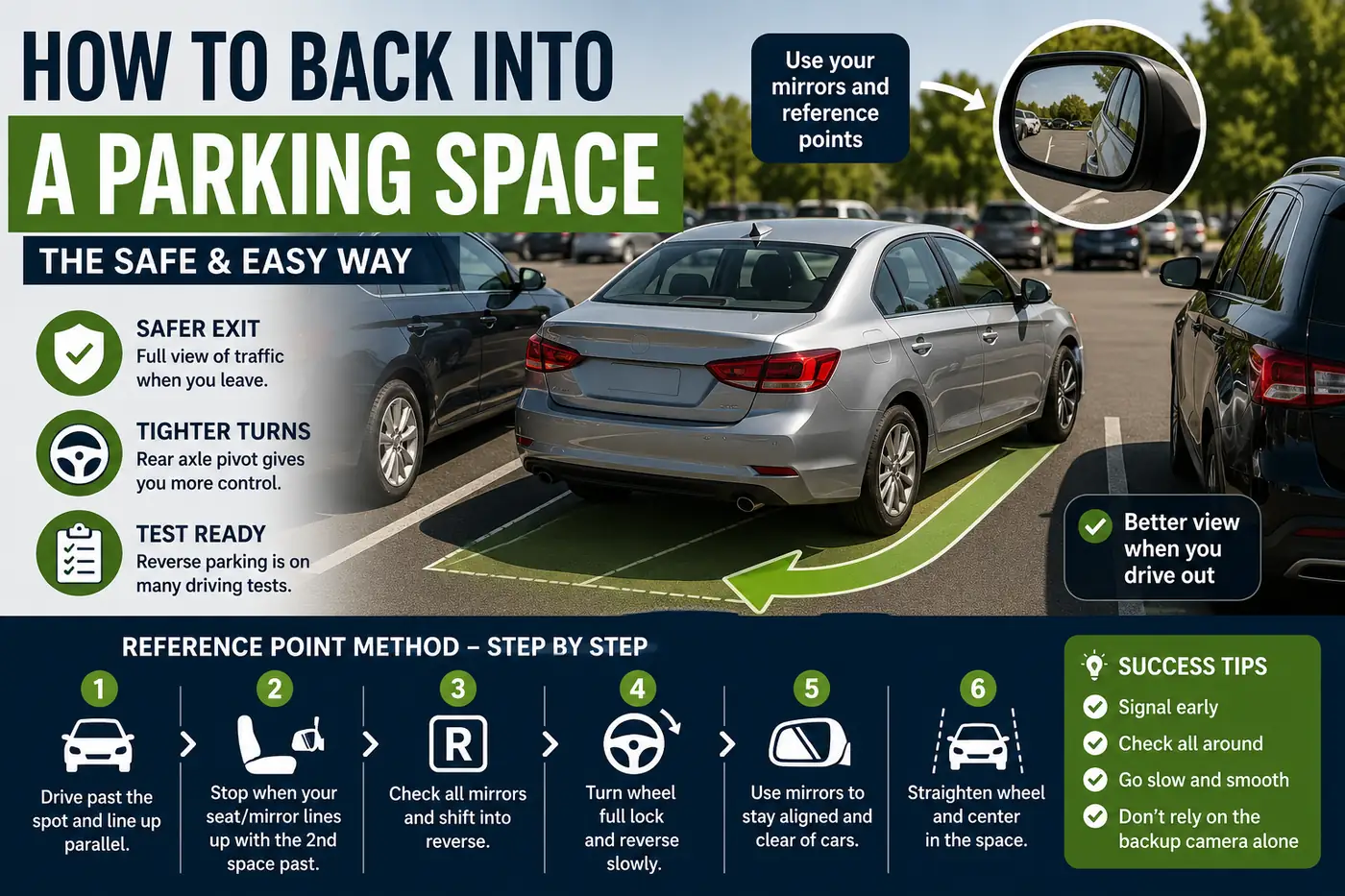
Backing in gives you a full view of the aisle when you drive out later, instead of reversing blind into traffic. This single habit is one of the essential driving skills for beginners that instructors introduce early, because it removes the riskiest part of any parking maneuver: exiting. Three things make backing in worth the extra effort at the start.
Better visibility on exit. When you leave a space nose-first, your windshield faces the aisle, giving you a wide view of pedestrians, carts, and passing cars.
Sharper turning radius. Your rear axle acts as the pivot point when reversing, which lets you turn into tighter perpendicular spaces than you can moving forward.
Road test relevance. Reverse or bay parking appears on many state driving exams, so practicing it now doubles as test preparation.
Never rely on your backup camera or mirrors alone. Safe reversing needs full awareness of everything around the car, not just what one screen or mirror shows.
What Safety Checks Should You Do Before Backing In?
Complete three checks before you turn the wheel. Signal early, at least two to three space-lengths before your target spot, so drivers behind you know your plan. Scan the space itself for shopping carts, low curbs, or tight clearance next to neighboring cars. Then do a full sweep of your rearview mirror, both side mirrors, and your shoulder blind spots before shifting into reverse.
How Do You Back Into a Parking Space Step by Step?
The most reliable technique for beginners is the reference-line method, sometimes called the two-space-past method. Follow these six steps in order.
Position your vehicle parallel to the row. Drive past your target space and line your car up parallel to the parked vehicles, leaving about four feet of lateral clearance from their rear bumpers.
Find your reference point. Keep driving forward slowly until your seat, or your side mirror, lines up with the outer edge of the second space past your target. Come to a complete stop here.
Shift into reverse and check your surroundings. Turn on your hazards if the lot is busy, look over both shoulders, and check all three mirrors before you start moving.
Turn the wheel to full lock. Creep backward slowly, controlling your speed with the brake, and turn the steering wheel all the way toward the side of the space.
Watch your side mirrors as you ease in. Your near mirror should show your rear bumper clearing the corner of the adjacent car. Your far mirror should show equal spacing from whatever is on the opposite side.
Straighten the wheel and finish centered. Once your car is parallel with the lines, turn the wheel back about one and a half full rotations and reverse straight until you’re fully inside the space.
How Do You Use Mirror Reference Points While Reversing?
Your side mirrors work as visual anchors that remove the guesswork from steering timing. During initial setup, your mirror lines up two spaces past the target and you come to a complete stop before turning full lock. As the target line appears in your nearest mirror, keep creeping and keep turning. Once your car body looks parallel to the lines in both mirrors, straighten the wheel back about one and a half rotations. When your side mirror lines up with the mirror of the car next to you, stop completely and shift into park.
Should You Rely on a Backup Camera When Reversing?
No, not by itself. A backup camera is a useful backup, not a replacement for mirrors and head checks. The screen shows ground-level hazards, distance to a curb or wall behind you, and trajectory lines, which is genuinely useful. What it misses is just as important: pedestrians approaching from the side, tall vehicle corners, and the front-end swing of your own car. When you reverse into a space, your front bumper swings out in the opposite direction of your turn, so you still need to glance forward and to the sides, not just at the screen.
If you’re weighing which local school teaches this well, CMSC Driving School in West Boylston, Massachusetts builds reverse parking and mirror discipline directly into its road test prep sessions.
What Mistakes Do Beginners Make When Backing Into a Space?
Most reverse-parking mistakes come down to timing, not effort. Turning too late leaves the car crooked or crossing into the next space; the fix is to pull forward, realign parallel to the row, and start again rather than trying to correct mid-maneuver. Ignoring the front swing, meaning staring only at the rear mirrors while turning, lets the front bumper clip a neighboring car; keep at least four feet of clearance during your initial setup to avoid this. Dry steering, or turning the wheel while the car is completely stopped, wears down your tires faster than it needs to; keep the car moving at a slow creep while you steer instead. These are some of the most common mistakes new drivers make in their first few weeks behind the wheel, and reverse parking tends to surface them early.
What Do Driving Test Examiners Look For During Reverse Parking?
Examiners are grading control and positioning, not speed. They want to see you signal your intent before stopping, complete a full head check before shifting into reverse, hold a steady slow speed using the brake rather than the gas, use your mirrors instead of staring at the backup camera screen, and land the car centered between the lines without touching a curb. Before test day, run through a full driving test checklist for beginners so the reverse-parking portion is not the only thing you’re prepping for.
Driving schools that build reverse parking into structured lessons tend to produce more consistent results than solo practice alone. Safe Pass Driving School in Ohio and NOLA Driving Institute, with locations in Metairie and Laplace, Louisiana, both include dedicated parking-lot sessions in their behind-the-wheel packages.
How Can You Practice Backing Into a Parking Space?
Start in an empty lot using light posts or painted lines before you attempt reverse parking between two cars. Angle your side mirrors slightly downward so you can see the ground lines clearly while you’re still learning distances. If you have a friend available, have them stand a safe distance away and give you real-time feedback on how close you are to the lines. Repetition in a low-pressure space builds the muscle memory that makes backing in feel automatic once you’re parking between occupied spaces.
What to Do Next
Reverse parking is one piece of a larger skill set that driving schools teach in a structured order. If you’re comparing programs beyond this guide, our full roundup of the best driving schools in Ohio breaks down pricing and curriculum across the state’s top options.
FAQ
Why is backing into a parking spot illegal?
Backing in generally isn’t illegal. It’s legal in all states and often recommended by driving instructors and safety organizations. A small number of specific lots, like certain fire lanes or loading zones, post signage requiring forward-in parking only, so check posted signs before assuming a rule against it applies to your lot.
Is it easier to reverse into a parking space?
It takes more practice upfront, but many drivers find it easier once they learn the reference-point method, since your rear axle gives you a tighter turning radius. Most of the difficulty new drivers feel comes from unfamiliar steering timing, not the maneuver itself.
What is the trick to backing into a parking space?
The trick is using a fixed reference point instead of guessing. Pull parallel to the row, stop when your seat or mirror lines up with the second space past your target, then turn the wheel to full lock while creeping backward slowly and watching both side mirrors as you straighten out.
What is the psychology behind backing into a parking spot?
Some drivers back in out of habit or a sense of control, since it lets them see and plan their exit in advance. Others avoid it simply because the entry maneuver feels harder, even though the exit is objectively safer.
Why is backing a high-risk maneuver?
Backing up feels riskier because your visibility is more limited than driving forward, and you’re relying on mirrors and head checks instead of a direct view. The maneuver itself isn’t inherently dangerous: doing it slowly in a controlled parking lot, with full mirror checks, is safer than reversing blind into moving traffic later.