How to Handle a Tire Blowout While Driving in 2026
A tire blowout while driving can happen in a fraction of a second, and how you respond in that moment often decides whether you keep control of your car. Updated July 2026: this guide breaks down the exact steps for handling a blowout safely, based on guidance from AAA, Allstate, and certified driving instructors. A loud explosion shatters the quiet inside the cabin, the steering wheel jerks violently, and your vehicle threatens to veer off course.
Your natural human instincts, like slamming on the brakes and yanking the wheel away from danger, are almost always wrong. Hard braking during a blowout is the primary reason controllable incidents turn into dangerous spins or rollover accidents.
Whether you are mastering essential driving skills for beginners or refreshing your defensive driving knowledge, knowing how to handle a tire blowout is critical for every driver.
In this guide, you’ll find:
- The exact step-by-step response sequence for a blowout
- How front and rear tire blowouts behave differently
- What to do once you are safely stopped on the shoulder
What Does a Tire Blowout Sound and Feel Like?
A tire blowout sounds like a loud bang or gunshot-like pop, followed by a rushing whoosh of escaping air and a rhythmic thump-thump-thump as shredded rubber slaps the wheel well. Recognizing what is happening within the first second gives you a real advantage in staying calm and reacting correctly.
A blowout typically unfolds in three sensory phases. First, you hear the sound: a sharp bang followed by that flapping thump. Second, you feel the pull, an immediate, strong drag toward the side of the damaged tire. Third, you feel the vibration, a strong shake that travels through the floorboards, seat, and steering wheel.
What Should You Do During a Tire Blowout? Step by Step
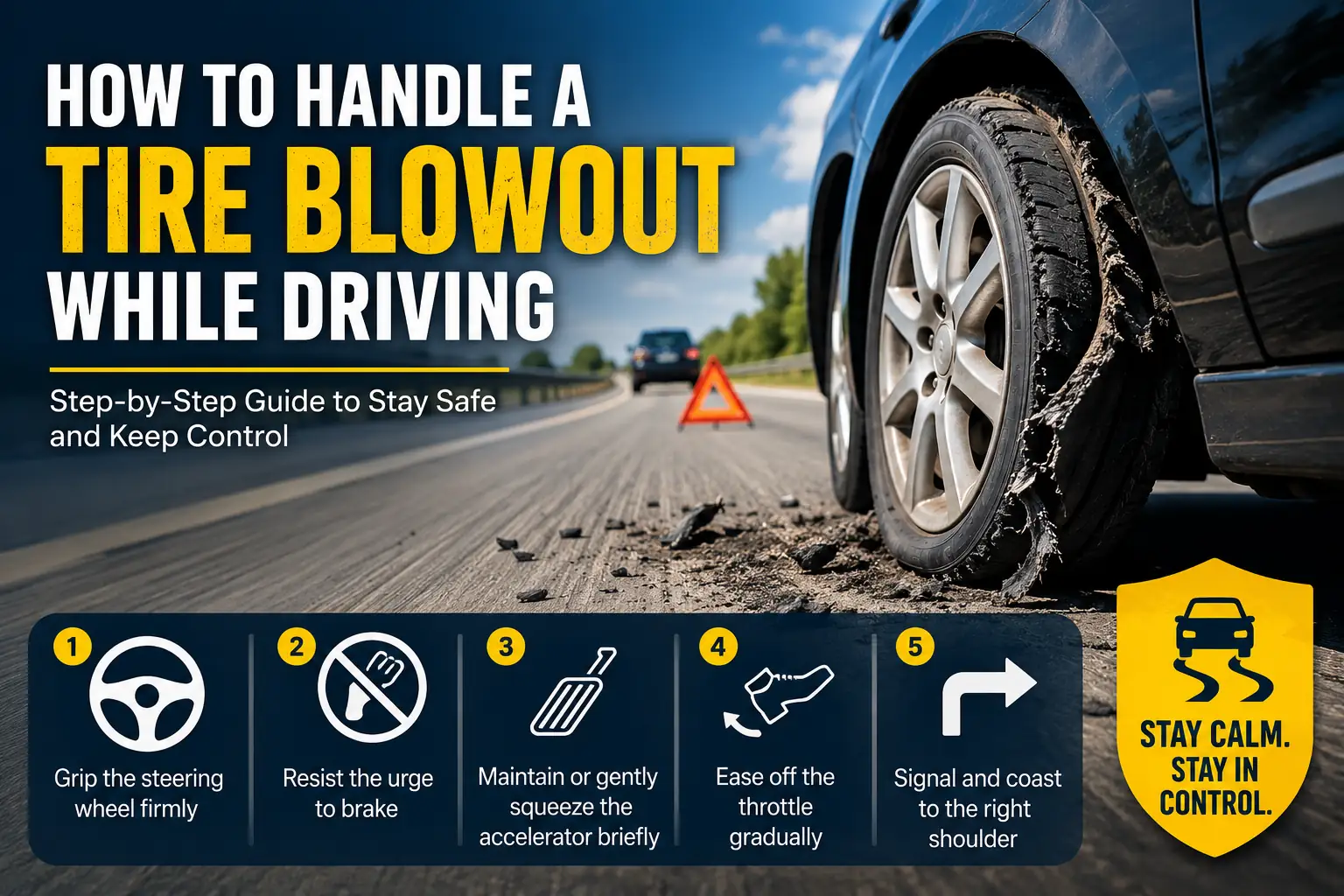
The first and most important step is to grip the steering wheel firmly and resist the urge to brake, keeping the car tracking straight until it naturally slows down. Follow this sequence to bring your car safely to a stop.
1. Grip the steering wheel firmly with both hands (seconds 0 to 2)
Lock your hands at the 9 and 3 o’clock positions immediately. The vehicle will pull violently toward the side of the failed tire, so exert firm, steady pressure to keep the wheel pointed straight ahead. Avoid jerking or overcorrecting.
2. Resist the urge to slam on the brakes (seconds 2 to 4)
Do not touch the brake pedal. Sudden braking shifts the vehicle’s weight forward onto the collapsed tire, which magnifies the drag on one side and can throw the car into an uncontrollable spin.
3. Maintain or gently squeeze the accelerator briefly (seconds 4 to 6)
It sounds counterintuitive, but keeping your foot on the gas, or giving it a brief squeeze, counteracts the sudden deceleration drag and helps stabilize the car’s weight balance so you can regain directional control.
4. Ease off the throttle gradually (seconds 6 to 15)
Once the vehicle is stabilized and tracking straight, slowly lift your foot off the gas pedal. Let the natural drag of the flat tire and engine braking reduce your speed on its own.
5. Signal and coast to the right shoulder (below 20 to 30 mph)
Once your speed drops safely below 30 mph, check your mirrors, turn on your right-hand signal, and gently guide the car toward the right shoulder or an off-ramp. Apply light, progressive braking only once the car is nearly stopped.
The core rule of blowout recovery is to drive through the blowout before trying to stop. Focus your initial energy on keeping the steering wheel straight; deceleration happens naturally once the vehicle is stabilized.
How Does a Front Blowout Differ From a Rear Blowout?
A front tire blowout pulls the steering wheel hard toward the failed side, while a rear blowout causes the back of the car to sway or fishtail instead of tugging the wheel. The core response rules, a firm grip and no hard braking, apply to both, but the sensation and the correction differ.
With a front blowout, the danger is a sudden drift into another lane or oncoming traffic, so the correction is heavy, steady steering input held straight ahead against the drag. With a rear blowout, the danger is a full spin or an overcorrection rollover, so the correction is to keep the wheel straight and let the rear end settle rather than counter-steering aggressively.
Understanding how balance shifts across different driving conditions, such as learning how to drive on ice, helps build the muscle memory required to stay calm during sudden traction loss.
How Should You React in an SUV, EV, or With Run-Flat Tires?
SUVs and trucks need extra-smooth steering inputs because their higher center of gravity raises rollover risk if you jerk the wheel or brake hard during a blowout. Different vehicles and tire technologies behave differently once a tire fails, so it helps to know what to expect before it happens.
SUVs and light trucks
Keep steering inputs smooth and subtle. A higher center of gravity makes these vehicles significantly more susceptible to rollover if you overcorrect.
Heavy electric vehicles
EVs are much heavier than gas-powered cars because of their battery packs, which means greater momentum and longer stopping distances. Rely on natural coasting deceleration; sudden regenerative braking can act like hard brake pressure and cause quick rear traction loss if a rear tire fails.
Run-flat tires
Reinforced sidewalls prevent the rim from crushing the rubber after pressure loss, so you may not hear an explosive pop at all. Instead, a low tire pressure warning light illuminates along with a stiffer ride. Run-flats typically allow up to 50 miles at reduced speeds, usually under 50 mph, but you should still avoid sudden high-speed maneuvers.
If you’re preparing for a road test in Ohio, schools like Safe Pass Driving School Ohio cover emergency vehicle control as part of behind-the-wheel training, so students practice these scenarios before they ever happen on a real highway.
What Should You Do Once You’re Fully Stopped?
Once stopped, turn on your hazard lights immediately, pull as far off the road as possible, and stay inside your vehicle if the shoulder is narrow and traffic is moving fast. Getting off the active road surface safely is only half the battle; a highway shoulder carries its own hazards.
Activate your hazard flashers right away to signal to oncoming drivers that your vehicle is disabled. Pull as far off the road as possible, and never stop in an active lane or on a narrow left shoulder near high-speed lanes unless it’s unavoidable. Set the parking brake, especially on an inclined shoulder, so the car cannot roll.
If you’re on a narrow shoulder with fast traffic passing close by, stay inside the vehicle with your seatbelt fastened and call roadside assistance rather than stepping out. If it is safe to exit, place warning flares or triangles 50 to 100 feet behind your vehicle to alert approaching traffic.
New drivers in Massachusetts often practice these exact shoulder-safety procedures at schools like CMSC Driving School West Boylston MA, since panic and poor situational awareness on shoulders are among the common mistakes new drivers make.
How Can You Prevent a Tire Blowout?
Most blowouts are preventable and caused by underinflated tires, worn tread, or an overloaded vehicle, which makes checking tire pressure monthly the single best prevention step. A few consistent habits dramatically lower your risk.
Check tire pressure monthly
Underinflation is the leading cause of tire blowouts. When a tire lacks sufficient air, its sidewalls flex excessively, generating internal heat that breaks down the rubber bonding. Always check pressure cold, using the PSI recommendation on your driver’s door jamb.
Inspect tread depth regularly
Worn tires lack resistance against punctures from nails and sharp debris. Replace tires once tread reaches 2/32 of an inch.
Watch for high summer temperatures
Friction combined with hot summer asphalt increases internal tire pressure and heat build-up, so inspect tire health closely before long road trips in the heat.
Avoid overloading your vehicle
Exceeding your car’s maximum load capacity places immense stress on tire sidewalls and dramatically increases the risk of structural failure.
Defensive driving courses, like those offered through 843LetsDrive Driving School in South Carolina, include hands-on training for these preventive habits alongside standard road test preparation.
Frequently Asked Questions
Should you brake during a tire blowout?
No. Braking hard during a blowout shifts your car’s weight forward onto the damaged tire, which can cause the vehicle to spin or roll. Instead, ease off the accelerator gradually and let your speed drop naturally before applying light brakes once you’re below about 20 to 30 mph.
Can you keep driving after a tire blowout?
You can coast a short distance to reach a safe shoulder, but you should not keep driving on a blown tire. Doing so damages the wheel rim and suspension and increases your risk of losing control. Pull over as soon as it’s safe and call roadside assistance or change the tire yourself.
What causes most tire blowouts?
Underinflated tires cause most blowouts, because low pressure lets the sidewalls flex excessively and build up heat that breaks down the rubber. Worn tread, road debris, and overloading your vehicle beyond its rated capacity are the other leading causes, especially during hot summer months.
How long can you drive on a run-flat tire after a blowout?
Most run-flat tires let you drive up to about 50 miles at reduced speeds, typically under 50 mph, after a pressure loss. This isn’t a permanent fix, so plan to repair or replace the tire as soon as possible instead of treating it as a long-term solution.
Is a tire blowout more dangerous on the highway?
Yes. Higher speeds mean less reaction time and a greater risk of losing control or triggering a rollover, especially in SUVs and trucks. A firm, steady grip on the wheel and avoiding sudden braking matter even more at highway speeds than in slower city traffic.
| Ready to Build Stronger Driving Skills? Whether you’re a new driver or brushing up before a road trip, hands-on instruction turns these emergency steps into muscle memory. Find Certified Driving Schools in Washington and Explore More Driving Safety Tips |